 (+351) 932 224 792
  info@luznurcapital.com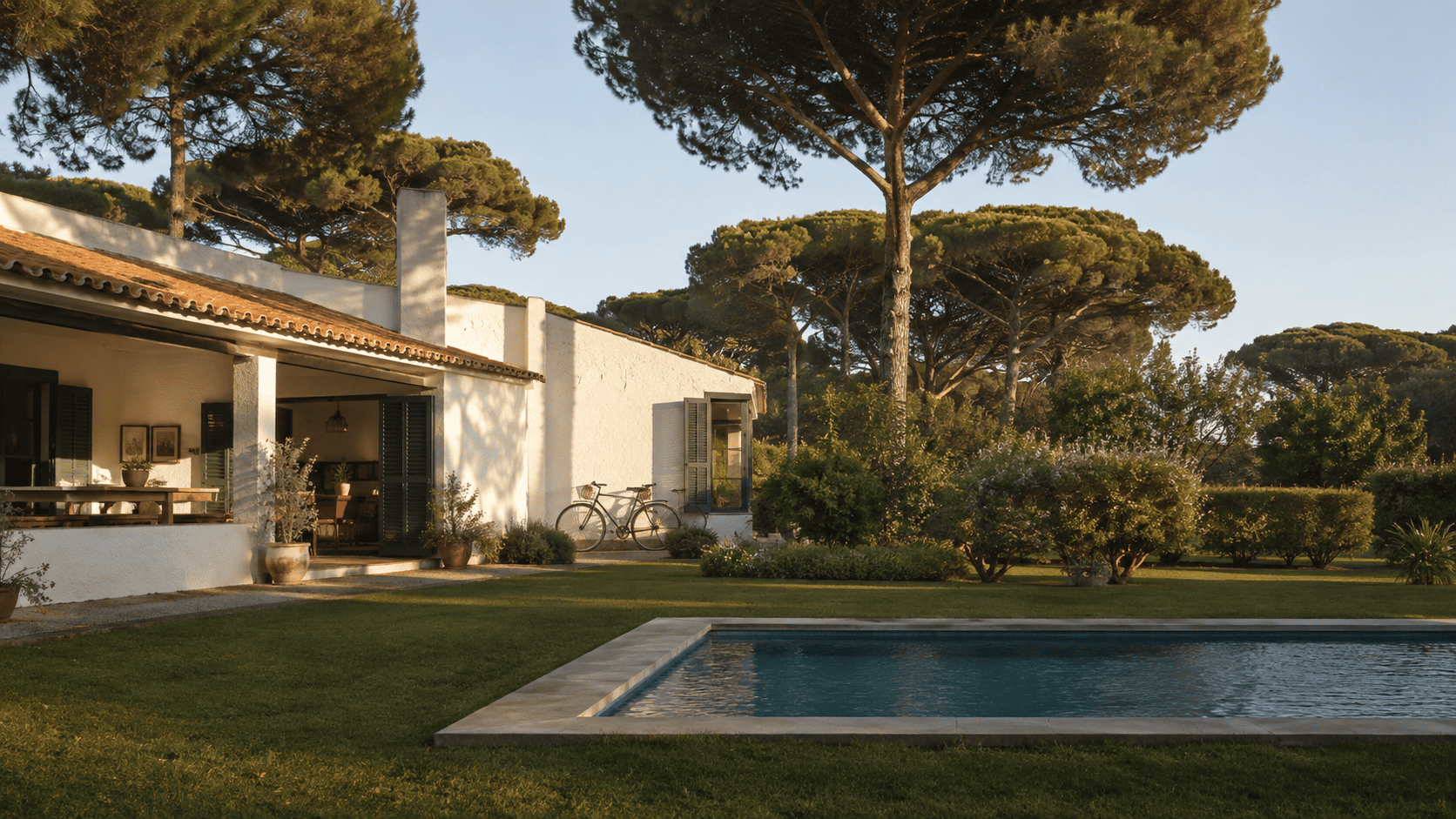
Where to live in Portugal with school-age children
Portugal has no school catchment system. International schools may admit from anywhere in the country, and nothing legally prevents a family living in Setúbal from enrolling a child in Cascais.
That freedom is the reason families get this decision wrong. The absence of a rule feels like the absence of a constraint, so the property search proceeds on views, price, and character, and the school question is treated as something to sort out afterward. It resolves itself into a commute that has to be driven twice a day, in traffic, for as long as the child is in school. Ten years of a fifty-minute run in each direction is not a logistical detail. It is the shape of family life.
The school decision does not restrict where you can buy. It restricts where you can live well. This guide is about the second thing.
The commute test
Before considering any area, establish three numbers for the specific school under consideration.
Door to gate at 8am on a Tuesday in November. Not the distance, not the time Google returns at 3pm in August. Portuguese traffic on the approaches to Lisbon and across the bridges bears no relationship to off-peak conditions, and the difference is routinely twenty to thirty minutes each way.
Whether a school bus serves the area. This is the most underused piece of information available to a relocating family. Most established international schools publish their route networks, and those routes are the real catchment map — they show precisely which neighborhoods the school considers within its orbit, drawn by people who do the journey daily. A published route turns an unworkable commute into a manageable one, because the child travels and the parent does not. Check the routes before shortlisting neighborhoods, not after.
The return trip at 6pm. After-school activities, sport, and enrichment programs end later than the school day, and the evening run is frequently worse than the morning one. Families who model only the morning discover the problem in October.
Everything below assumes those three numbers have been established for the actual school, not the region.
Greater Lisbon: the western corridor
The majority of international schooling in the Lisbon area sits in a narrow belt running west from the city through Oeiras, Carcavelos, Estoril, and Cascais, and inland to Linhó and Sintra. Long-established British, American, and international institutions cluster here, and so do the families who use them.
Carcavelos and Oeiras put you closest to the densest concentration of schools and to the A5 and the coastal line into Lisbon. Property is a mixture of apartments and family houses, and pricing is lower than Cascais proper. It works for a family where one parent commutes into Lisbon and the school run goes the other way.
Estoril and Cascais offer the most complete family infrastructure in the country: pediatric healthcare, sports clubs, a marina, and an established international community that means a newly arrived child finds other newly arrived children. Property is expensive and the town functions year-round, which is the crucial difference from the coastal resort options further south. Cascais in February is a working town, not a closed one.
Linhó, Quinta da Beloura, and the Sintra approaches trade proximity to the coast for space, gardens, and gated communities, at prices below equivalent Cascais stock. Several schools sit directly in this corridor, which makes the commute short in the direction that matters. The trade-off is that Sintra’s microclimate is genuinely different — cooler, damper, more cloud — and families who fell for Portugal in a Lisbon summer should visit in January before committing.
Central Lisbon is workable if the chosen school is one of the city institutions rather than a western one. Parque das Nações in particular functions well for families: modern apartments, flat ground, cycle paths, riverside space, and schools within the district. Restelo and Belém offer a quieter, greener, more residential version of the city with schools nearby. What central Lisbon does not offer is a garden at a price most families will accept, which is the trade every returning family debates.
The Setúbal peninsula
This is the part of the map most relocating families never look at, and for a certain kind of buyer it is the best answer available.
The peninsula south of the Tagus — Almada, Seixal, Sesimbra, Palmela, Setúbal, and the Arrábida coast — offers house-and-garden living, genuine coastline, pine forest, and pricing well below the Cascais corridor, roughly thirty minutes from Lisbon when the bridges cooperate.
Herdade da Aroeira is the clearest example. A gated resort in Charneca de Caparica set in umbrella pine with two golf courses, low-density villas on generous plots, and Atlantic beaches minutes away. Verdizela, immediately adjacent, offers a similar profile of detached houses in forest at lower density than anything comparable on the northern bank. Both deliver a version of family life — a garden, a pool, children on bicycles, a golf course at the end of the road — that costs substantially more in Cascais and is largely unavailable in Lisbon at any price.
The schooling answer for this area is more robust than most buyers expect. St. Peter’s International School in Palmela is the anchor: a large campus of around 37,000 square meters, serving children from infancy to eighteen, running both a Portuguese pathway and an international pathway with Cambridge and IGCSE from lower secondary and the IB Diploma at senior level. Since 2019 it has been part of the Inspired Education Group. Its bus network runs to Aroeira, Costa da Caparica, Sesimbra, Quinta do Conde, Setúbal, Barreiro, Alcochete and Montijo, and Campo Grande in Lisbon — which is to say the school has already mapped the peninsula for you. Other options exist in Palmela and Seixal, including bilingual and Cambridge provision at smaller scale.
Two practical points shape the peninsula decision.
The bridge determines everything. Aroeira, Verdizela, and Costa da Caparica depend on the 25 de Abril bridge for Lisbon access, and it is a genuine chokepoint at peak hours. Palmela, Setúbal, and Quinta do Conde sit closer to the Vasco da Gama crossing and to the A2, which changes the calculation for a parent working in Lisbon. If one parent commutes into the city daily, establish which bridge and test it in real conditions before buying.
The peninsula answers the Comporta problem. St. Peter’s operates a boarding residence for students aged fourteen to eighteen, positioned between Lisbon and Comporta. For a family with a home on the Alentejo coast and a teenager, that is a serious option and it is almost never mentioned in relocation content.
Porto and the north
Porto’s international schooling clusters on the western side of the city, in and around Foz do Douro, Boavista, and the corridor toward the coast — which is also where most international families settle, so the geography is unusually convenient. British, French, German, and international-curriculum schools all have long-established presences.
The list is shorter than Lisbon’s. The daily reality is frequently better. Porto is a smaller city with shorter journeys between home, school, and work, and families consistently report that the day is easier here than in the Lisbon area even where the school options are fewer.
Foz do Douro and Nevogilde offer coastal, low-rise, family-scale living close to the schools. Boavista works for a family wanting a central address with fast road access. Vila Nova de Gaia’s riverfront and Matosinhos offer lower entry points, with the metro network’s expansion changing journey times across the river.
Porto also functions fully year-round, which the resort markets do not.
The Algarve
The Algarve has genuine international schooling, concentrated in two areas: the Golden Triangle around Almancil and Vilamoura, serving Quinta do Lago and Vale do Lobo, and the western Algarve around Lagos and Luz. Both have British-curriculum provision through to senior level.
Three honest constraints belong in any Algarve family decision.
Seasonality changes the social experience more than the weather. A resort address that is full of children in August can be quiet in February, and if a child’s school friends live thirty minutes away in a different resort, weekday friendship becomes a driving commitment rather than a doorstep one. Families who thrive here are usually those who settle near the school rather than near the beach.
Distances are long and the roads are fast but singular. The A22 does most of the work, and an address east of Faro attending a school in Almancil is a real journey. The Golden Triangle to western Algarve run is not a school commute at all.
Provision thins at the senior end. Preschool and primary options exist across a wide area; sixth-form and IB provision is concentrated in fewer places. A family with a four-year-old has considerable geographic freedom in the Algarve. The same family with a fifteen-year-old has much less.
The Algarve works well for families whose children are already settled, who are choosing this life deliberately, and who buy within reach of the school rather than within reach of the view.
Comporta and the Alentejo coast
There is no international day school on the Alentejo coast. This is the single most important fact for any family considering Comporta, Melides, or Carvalhal as a year-round base with children.
Three realistic responses exist. Use the peninsula: the Palmela campus with its bus network and, from fourteen, its boarding residence. Treat Comporta as a weekend and holiday property with a term-time base in Lisbon or on the peninsula, which is what most owning families actually do. Or buy there once children have finished school.
What does not work is buying a Comporta house in March on the assumption that the school question resolves itself by September. It does not resolve; it becomes a two-hour daily reality or a boarding decision made under time pressure.
Madeira
Funchal supports international schooling and functions as a year-round community rather than a seasonal one, with a mild climate and short internal distances. The constraint is air connectivity: everything requires a flight, and for families with grandparents, specialists, or a business on the mainland, that becomes a recurring cost in both money and time. It suits families making a genuine, settled move rather than those maintaining strong ties elsewhere.
How the answer changes with the child’s age
Toddlers and preschool. Provision is widespread and the geographic constraint is weak. This is the stage at which families feel freest and make the most portable decisions, and it is also the stage at which they most frequently buy somewhere they will need to leave. A four-year-old becomes a fourteen-year-old in the same house.
Primary years. The commute becomes the dominant variable, because it is now daily, non-negotiable, and paired with after-school activities. This is the stage where the difference between a fifteen-minute and a forty-five-minute run reshapes the family week.
Secondary and sixth form. Options narrow sharply and continuity matters most. A teenager two years from university examinations should not be moved for a property decision, and the geography of senior provision — heavily concentrated in Greater Lisbon, Porto, and a handful of Algarve and peninsula campuses — should be treated as fixed. Independence also becomes a factor: a fifteen-year-old who can reach friends, sport, and a town center without a parent driving has a materially better adolescence than one who cannot, which argues for walkable, connected areas over isolated ones at this stage.
Mixed ages. A family with a five-year-old and a fifteen-year-old is optimizing for the older child, because the older child’s options are scarcer and the stakes are nearer.
Where families most often go wrong
Buying before the school question is settled. The property is the harder thing to undo. Establish the school and the commute first, then search within the resulting area.
Testing the area in August. Every coastal Portuguese location is at its best in summer. Visit the shortlisted neighborhood in a wet February week, on a Tuesday, and see what is open and who is around.
Ignoring the published bus routes. They are free, specific, and they answer the exact question being agonized over.
Optimizing the house and not the week. A larger garden forty minutes further out is paid for twice daily by whoever drives.
Assuming the current stage is the permanent one. School-age children have a ten to fifteen year horizon. The property decision should be tested against the end of that period, not the beginning.
A workable sequence
Identify the school or the small group of schools that fit the child’s curriculum, language, and stage.
Obtain the published transport routes for those schools and treat them as the map of viable areas.
Shortlist neighborhoods within those routes, then test the door-to-gate journey in real morning and evening conditions.
Visit the shortlist out of season and on a weekday.
Begin the application process well in advance of the intended move, and coordinate its timing with the property timeline rather than assuming the two will align.
Only then commit to a purchase.
Families who follow that order tend to settle quickly. Families who reverse it spend the first two years fixing a decision they made in a week.
FAQ
Do Portuguese international schools have catchment areas?
No. International schools in Portugal admit from anywhere in the country, and there is no residence-based catchment system. The practical constraint is the daily commute rather than any regulation, which is why families should test journey times before choosing a neighborhood.
Where do most international families live in the Lisbon area?
Predominantly in the western corridor running through Oeiras, Carcavelos, Estoril, Cascais, and inland toward Linhó and Sintra, where most international schooling is concentrated. Parque das Nações, Restelo, and Belém suit families whose chosen school is within Lisbon itself.
Is the Setúbal peninsula viable for families with children?
Yes. Areas including Herdade da Aroeira, Verdizela, Charneca de Caparica, Sesimbra, Palmela, and Setúbal offer house-and-garden living at lower cost than the Cascais corridor, with international schooling anchored at Palmela and an established school bus network covering much of the peninsula. The main variable is which Tagus bridge an area depends on for Lisbon access.
Can we live in Comporta with school-age children?
Not straightforwardly. There is no international day school on the Alentejo coast. Practical options are the Setúbal peninsula with its school transport network, boarding from age fourteen at the Palmela campus, or treating Comporta as a weekend and holiday property with a term-time base elsewhere.
Is the Algarve a good place to raise children?
It can be, for families who buy near the school rather than near the beach. International schooling concentrates around Almancil and Vilamoura in the Golden Triangle and around Lagos and Luz in the west. The constraints are seasonality, which affects the social experience more than the weather, long distances between resorts, and fewer options at senior level than at primary.
Is Porto easier than Lisbon for families?
Often, yes. Porto has fewer international schools, but they cluster on the western side of the city where most international families settle, and journeys between home, school, and work are shorter. The city also functions year-round, unlike the resort markets.
How do I work out whether a commute is realistic?
Test the actual door-to-gate journey at around 8am on a weekday in term time, and again on the evening return after after-school activities finish. Off-peak and summer journey times understate real conditions on the Lisbon approaches and the bridges by a substantial margin.
Should we choose the school or the house first?
The school. The property search should then be conducted within the area that school makes livable. Reversing the order is the most common and most expensive mistake families make when relocating to Portugal.
Does the right area change as children get older?
Considerably. Preschool and primary provision is geographically wide, while senior and sixth-form provision concentrates in Greater Lisbon, Porto, and a few Algarve and peninsula campuses. Teenagers also benefit from areas where they can reach friends and activities independently. A property decision made for a four-year-old should be tested against what that child will need at sixteen.
Is this article educational or relocation advice?
No. It offers general geographic and practical guidance as of August 2026 and is not advice on schooling, admissions, or relocation. School provision, transport arrangements, and curricula change; families should verify current details directly with the institutions concerned.
DISCLAIMER
Important information
This article is provided for general information only and reflects publicly available information as of August 2026. It does not constitute educational, admissions, immigration, or relocation advice, and it is not a recommendation of any school or institution.
Schools are referenced as geographic reference points to explain residential patterns. Curricula, age ranges, transport routes, boarding arrangements, and admissions processes are set by each institution, change over time, and should be verified directly with the school concerned. Luznur Capital has no affiliation with, and receives no consideration from, any school referenced.
Journey times described are indicative and vary substantially by time of day, season, and traffic conditions. Families should test any commute in real term-time conditions before making a property decision.
Luznur Capital is a licensed real estate brokerage and advisory firm (AMI 22354). It is not an education consultancy, immigration advisor, or law firm. Independent professional advice should be obtained on residency, tax, and legal matters relating to any relocation.
General information as of August 2026, not educational, admissions, or relocation advice. Schools are referenced as geographic reference points only; verify current arrangements directly with each institution. Luznur Capital (AMI 22354) has no affiliation with any school named.
CLOSING
Relocating to Portugal with children
The school decides the area, and the area decides what is available. Luznur Capital advises international families relocating to Portugal across Greater Lisbon, Cascais, the Setúbal peninsula, Porto, the Algarve, and Madeira, sequencing the property search around the schooling decision rather than the other way round, with coordinated legal, tax, and immigration support.
To discuss a specific mandate, contact info@luznurcapital.com
Tag:
Category:
- Alentejo (1)
- Algarve (15)
- Almancil (5)
- Buyer Guides by Nationality (5)
- Buying in Portugal (21)
- Cascais (6)
- Comporta (6)
- Costs & Fees (2)
- Country Comparisons (2)
- D7 Visa (5)
- D8 Visa (4)
- Diplomacy (1)
- Eastern Algarve (3)
- Economy (9)
- Estoril (5)
- Foreign Bilateral Relations (3)
- GCC (2)
- GCC Investors Portugal (2)
- Golden Triangle Algarve (5)
- Golden Visa (1)
- Golden Visa Portugal (2)
- HNWIs (16)
- International Buyers (24)
- Investing in Portugal (29)
- Investment (6)
- Investment & Advisory (14)
- Lisbon (5)
- Lisbon (11)
- Market Data (6)
- Market Guides (8)
- Porto (6)
- Portugal (16)
- Quinta da Marinha (6)
- Quinta do Lago (11)
- Real Estate Portugal (32)
- Relocating to Portugal (14)
- Relocation (1)
- Residency & Investment (1)
- Sotavento Algarve (3)
- Tavira (7)
- Tourism (4)
- Vale do Lobo (5)
- Vila Real de Santo António (1)
- Vilamoura (5)
- Wealth Management (1)
- Wealth Management Portugal (4)