 (+351) 932 224 792
  info@luznurcapital.com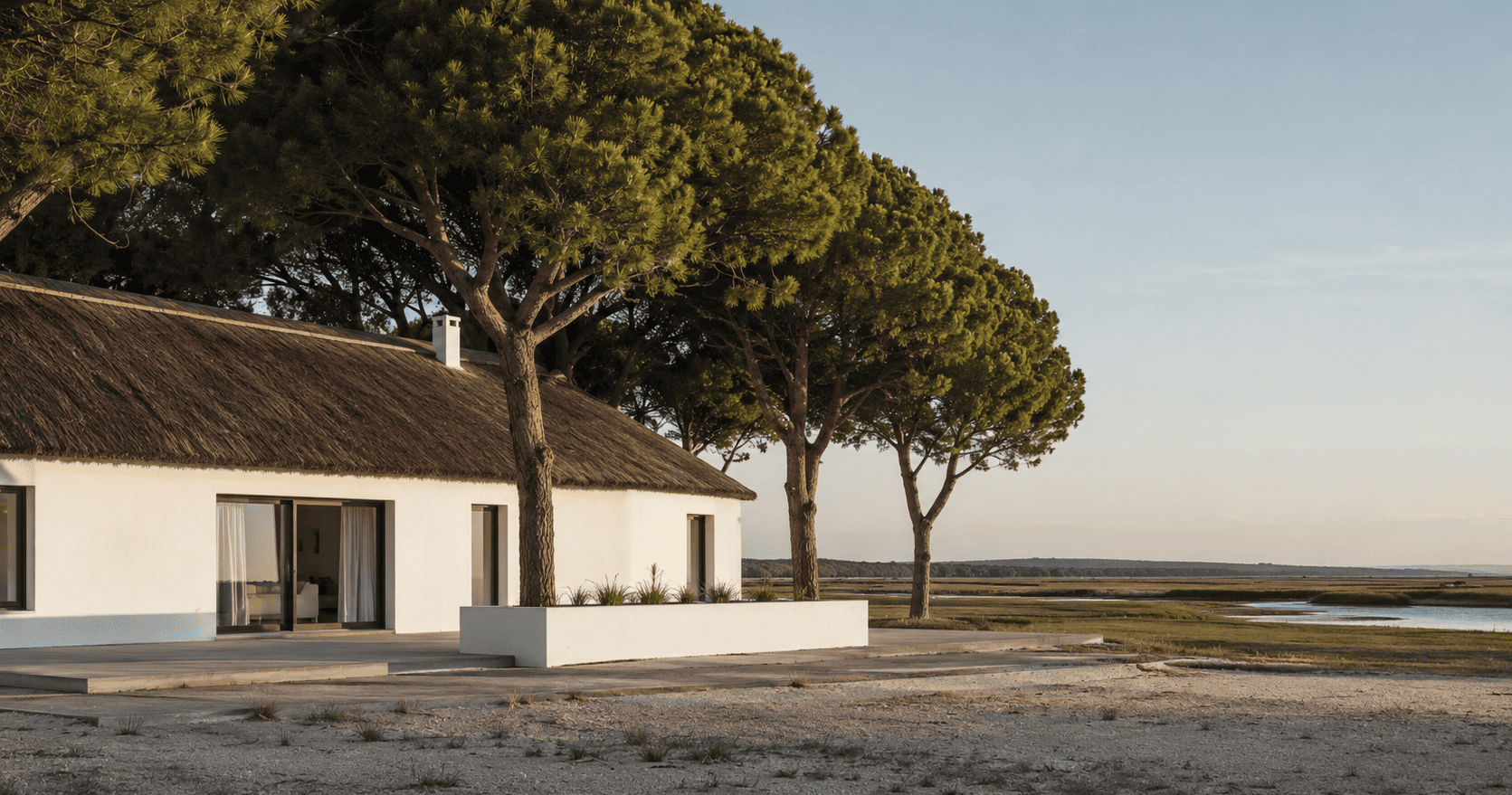
Comporta property market: a guide for international buyers
Comporta’s scarcity is a legal construction, not a natural one.
Sixty kilometers of Atlantic coastline south of Lisbon sat almost entirely undeveloped for seventy years because a single family owned most of it and chose to farm rice rather than build. The Espírito Santo family acquired Herdade da Comporta from the British-owned Atlantic Company in 1955 and held it until the group’s collapse. Layered on top of that ownership history is the Sado Estuary Nature Reserve, which caps density across much of the region.
The consequence is a coastline of pine forest, rice fields, and empty white-sand beaches an hour from a European capital, priced accordingly. The complication is that the ownership constraint has ended and the planning constraint is administered by municipalities that can revise it.
Anyone buying here on the assumption that the emptiness is permanent should understand what is already approved.
What Comporta is
Comporta sits on the Tróia peninsula and the Alentejo coast immediately south of it, spanning the municipalities of Alcácer do Sal and Grândola. It is roughly 65 minutes from central Lisbon via the A2 highway and the Vasco da Gama bridge, and comparably close to Lisbon airport, which is what makes it a genuine weekend property for French, British, Swiss, and Portuguese owners rather than a summer-only destination.
The area fragments into distinct sub-markets that behave differently: Comporta village itself, Pego, Carvalhal, Brejos da Carregueira, Muda, Torre, and Melides twenty minutes south. Tróia at the northern tip is a separate market with separate economics.
The aesthetic is unusually consistent: single-story white structures, thatched roofs, timber, rice fields, and umbrella pine. That consistency is not accidental, and the mechanism that produces it is one of the more consequential things a buyer needs to understand.
Pricing
Market data has placed prime Comporta property in the range of €6,800 to €10,700 per square meter. Against an INE national median of €2,111 per square meter in the third quarter of 2025, prime Comporta trades at three to five times the country as a whole.
Broad price bands observed across the market:
Building plots inside master-planned resorts have been quoted between roughly €800 and €1,800 per square meter of land. Buildable plots in Carvalhal or Brejos, frequently sold with an approved architectural project, have started around €950,000 and exceeded €3 million. Traditional and renovated houses in Brejos da Carregueira or Muda have generally transacted between €3 million and €5 million. Villas inside gated developments such as Sublime Comporta, Spatia, and CostaTerra have run from €4 million to €7 million. Finished homes inside the largest master-planned schemes have started around €3.5 million and moved well past €15 million for beachfront. Melides has generally sat 15% to 25% below Comporta for comparable product.
Reported growth for Comporta and Melides between 2023 and 2025 has been cited at around 28%, though the underlying methodology behind that figure is not published in detail and it should be treated as directional.
A caution on all of the above. Comporta transaction volumes are low, product is heterogeneous, and much of the market moves privately without ever reaching a portal. Published per-square-meter figures here are far less reliable than in a liquid urban market, and two properties at the same headline rate can be entirely different assets. Comparable evidence matters more here than in almost any other Portuguese market, and it is harder to obtain.
Three legally distinct markets, not one
This is the distinction that determines what you are actually buying, and it is almost never explained.
Master-planned resort property. Plots and homes inside approved Tourist Development Areas — the ADTs — and inside private condominium schemes. Development rights are already established at masterplan level, infrastructure is delivered by the developer, and what you can build is defined before you arrive. This is the lowest-risk route in terms of planning certainty and the highest in terms of paying for that certainty. Some schemes carry tourism licensing that permits letting; others do not.
Urban-classified private property in the villages. Existing houses and building plots within the village perimeters of Comporta, Carvalhal, Pego, Brejos, and Melides. Development rights depend on the municipal plan and the specific plot, and construction here is genuinely constrained. This is where most of the character stock sits and where the scarcity is most real.
Rustic land. Agricultural and forest land outside urban perimeters. This is where buyers lose money.
The rustic land trap
Foreign buyers are routinely shown large rustic parcels at prices that look extraordinary against the built market — ten hectares for less than the cost of a village house. The arithmetic only works if you can build, and generally you cannot.
Portuguese land is classified as urbano or rústico. Rustic land is protected for agricultural and forestry use, and new residential construction on it is not permitted as a matter of course. The common workaround presented to buyers is a pre-existing registered ruin, a ruína, on the basis that a ruin can be rebuilt. That route has narrowed considerably. The ruin must be properly registered, its footprint documented, and the reconstruction consistent with what was there — and municipalities have become markedly less willing to interpret a pile of stones as a dwelling.
Around Comporta, additional layers sit on top. The Sado Estuary Nature Reserve imposes its own restrictions. The National Ecological Reserve and National Agricultural Reserve — REN and RAN — overlay large areas of the Alentejo coast and prohibit or heavily restrict construction independently of the municipal plan. Coastal land may fall within the maritime public domain. A plot can be clear under one instrument and blocked under three others.
The only reliable answer comes from a written planning viability opinion from the relevant câmara municipal, obtained before any deposit is committed, alongside verification of REN, RAN, and reserve boundaries against the specific parcel. A seller’s assurance, an agent’s confidence, or the existence of a neighboring house built under earlier rules are none of them evidence.
The covenant layer
Comporta’s visual coherence is maintained by contract as much as by planning law. Plot-level and masterplan-level covenants govern building height, materials, color palette, roof form, pool dimensions, and landscaping. Inside the resort schemes these are extensive.
Buyers accustomed to owning land and building what they like should read these documents before falling for the architecture, because the architecture exists precisely because those documents restrict everyone. The covenants are what protects your view and your resale value, and they are also what stops you adding a second floor.
Verify what the covenants permit, how they can be amended, and by whom, before reservation. The developer frequently retains amendment rights.
What is already approved
In 2019, a consortium of Vanguard Properties, controlled by Claude Berda, and Amorim Luxury, controlled by Paula Amorim, acquired the real estate assets of the Herdade da Comporta fund for approximately €157.5 million, following the collapse of Grupo Espírito Santo. Vanguard holds the substantial majority.
Those assets comprise two Tourist Development Areas, now branded Terras da Comporta: Torre, in Alcácer do Sal, and Dunas, near Carvalhal in Grândola. Together they cover roughly 1,370 to 1,380 hectares. Planned investment across the project has been stated at around €2.3 billion over a development horizon of approximately fifteen years.
The approved content is substantial. Torre has been described as comprising 245 plots for detached homes, three tourist villages, two hotels, and two aparthotels, representing investment of up to €850 million. Dunas, a low-density scheme of around 1,010 hectares surrounded by 460 hectares of protected forest, carries plots of 3,000 to 12,000 square meters at a building index of 6%, permitting up to 726 housing plots. The developer has stated an intention to reduce this to approximately 310 plots to lower density, alongside two luxury hotels, the first with 142 rooms, 60 hotel villas, and 64 branded residences.
Separately, Discovery Land Company’s CostaTerra Golf and Ocean Club near Melides comprises 292 residences around a Tom Fazio course, with pricing that has started around €4 million. Muda Reserve, Spatia Comporta, Sublime Comporta, Comporta Beach and Golf Resort, and Les Terrasses de Comporta add further supply.
Two observations follow, and they point in opposite directions.
The first is that the developer’s density reduction at Dunas — from 726 plots to roughly 310 — is a deliberate choice to protect exclusivity and value. It is also a choice, not a legal cap, and choices can be revisited by the same owner or by a future one.
The second is that a market whose entire premise is emptiness has more than a thousand hectares of approved development in its pipeline, controlled principally by one consortium. Whether that consortium builds slowly and preserves scarcity, or accelerates, determines the medium-term supply picture more than any other variable. A fifteen-year buildout is manageable for values. A compressed one is not.
That is not an argument against buying in Comporta. It is an argument for knowing where a specific property sits relative to what is coming, and for treating the resort schemes and the village stock as exposed to that pipeline in different ways. Village property that cannot be replicated is structurally better protected than a resort plot with three hundred siblings.
Seasonality, and what it does to your numbers
Comporta outside July and August is very quiet. Restaurants close, the village supports perhaps a dozen open kitchens, and the social infrastructure contracts sharply.
For some buyers that stillness is the entire appeal, and for owners who want winter solitude an hour from Lisbon it is a genuine feature. It has three practical consequences that belong in any financial model.
Rental income is concentrated into a short window. A yield calculation built on peak-season weekly rates and annualized is wrong by a wide margin. Model the actual lettable weeks.
Short-term letting is regulated at municipal level, and Grândola and Alcácer do Sal each set their own position. Tourism-licensed accommodation inside a resort scheme operates under a different regime from a residential house registered for Alojamento Local, and the two should not be assumed equivalent. Confirm the specific position for the specific property before underwriting any rental income.
Resale liquidity is seasonal too. Comporta sells in summer. A property brought to market in November in a soft cycle can sit for a long time in a market this thin.
Anyone considering Comporta as a primary or long-stay residence should visit in February before committing.
Melides, and whether the arbitrage is real
Melides sits twenty minutes south and has attracted the attention that Comporta held a decade ago, with Christian Louboutin, Philippe Starck, and a succession of fashion names establishing a presence. It is a smaller village — a square, a church, a handful of restaurants, and a lagoon opening to the Atlantic — and pricing has generally run 15% to 25% below Comporta for comparable product, with some prime villa stock quoted at €6,500 to €10,500 per square meter.
The arbitrage argument is that the gap closes. It may. Two cautions apply.
The rustic land problem is more acute in Melides than in Comporta, because more of the attractive land is rustic and more of the inventory presented to buyers is unbuildable. The tempting ten-hectare parcel is a Melides phenomenon more than a Comporta one.
And the infrastructure that would justify convergence — restaurants, services, year-round activity — is precisely what Melides does not yet have. Buying early in an emerging market means holding through the period before the thesis is proven, which requires a longer horizon than most second-home buyers actually have.
Carvalhal offers a middle position: closer to Comporta’s infrastructure, below its pricing, with beach access.
Tróia is a different asset
The Tróia peninsula’s northern tip, reached by ferry from Setúbal or by road around the estuary, carries the Tróia Resort with apartments and villas around a golf course, a marina, and the Tróia Design Hotel. Product is predominantly apartments rather than land, entry points are far lower than Comporta’s, and the market behaves like a resort market rather than a scarcity market. There are however gated communities of luxury villas with good investment opportunities accessible through the right broker and networks.
It suits a different buyer with a different objective and should not be assessed against Comporta comparables.
Diligence specific to this market
Beyond standard Portuguese property diligence, five items matter disproportionately here.
Land classification and construction viability. Confirm urbano or rústico status, and where any construction or extension is contemplated, obtain written viability confirmation from the municipality. Check REN, RAN, the Sado Estuary Reserve, and maritime public domain boundaries against the parcel.
Registry against physical reality. Rural Alentejo property frequently carries discrepancies between the land registry, the tax record, and what stands on the ground. Historic outbuildings, agricultural structures, and boundary lines all require reconciliation.
Access and services. Confirm legal access rights over any intervening land, and confirm water, electricity, and wastewater arrangements. Isolated properties may rely on boreholes and septic systems whose licensing needs verification.
Covenants and masterplan rights. Read them, including who holds amendment rights.
Water. The Alentejo is water-stressed, and irrigation for large plots and gardens depends on licensed abstraction. Confirm what exists and what it permits.
Who this market suits
Comporta works for a buyer who wants Atlantic beach, pine forest, and design-led architecture within an hour of Lisbon, who values quiet over amenity, and who is buying primarily for use rather than for return. On that basis it delivers something with few genuine European equivalents.
It works poorly for a buyer who needs a walkable town functioning year-round, who requires meaningful rental yield, who wants liquidity on exit, or who is buying land on the assumption that permission follows purchase.
The pricing already reflects the scarcity. What it does not yet reflect is the pipeline, and the gap between those two is the question a buyer should be asking rather than the one most are asked to consider.
FAQ
How much does property cost in Comporta?
Prime Comporta property has been recorded in the range of €6,800 to €10,700 per square meter, this can vary, roughly three to five times the Portuguese national median. Buildable plots have started around €950,000, traditional houses in Brejos or Muda have transacted between €3 million and €5 million, resort villas between €4 million and €7 million, and beachfront homes well above €15 million. Transaction volumes are low and much of the market moves privately, so published rates are less reliable here than in urban markets.
Can I build a house on rustic land in Comporta?
Generally no. Rustic land is protected for agricultural and forestry use and does not carry residential development rights. The common exception involves a pre-existing registered ruin, but that route has narrowed and requires documented registration and a reconstruction consistent with the original. The Sado Estuary Nature Reserve, REN, RAN, and maritime public domain may each impose further restrictions. Obtain written viability confirmation from the municipality before committing funds.
Why is Comporta so expensive?
Supply has been constrained for seventy years, first because the Espírito Santo family owned most of the region and farmed it rather than developing it, and subsequently by nature reserve density caps and municipal planning restrictions. That scarcity, combined with proximity to Lisbon and a distinctive low-rise aesthetic, has produced pricing well above the rest of the Portuguese market.
Is Comporta going to be overdeveloped?
Approximately 1,370 to 1,380 hectares across the Torre and Dunas developments have been approved, with roughly €2.3 billion of planned investment over about fifteen years, principally controlled by the Vanguard Properties and Amorim Luxury consortium. The developer has stated an intention to reduce density at Dunas from a permitted 726 plots to around 310. The pace of delivery is the single largest medium-term variable for values, and it rests with the developer rather than with planning law.
Is Comporta or Melides the better buy?
Melides has generally priced 15% to 25% below Comporta and has attracted significant attention, which supports the convergence argument. Against that, more of the attractive Melides land is rustic and unbuildable, and the infrastructure that would justify convergence has not yet arrived. Melides requires a longer holding period and more careful land diligence.
Can I rent out a property in Comporta?
It depends on the property’s licensing and the municipality. Tourism-licensed accommodation inside a resort scheme operates under a different regime from a residential property registered for Alojamento Local, and Grândola and Alcácer do Sal each set their own restrictions. Income is also heavily concentrated into the summer months, so a yield model built on peak weekly rates annualized will substantially overstate returns.
How far is Comporta from Lisbon?
Around 65 minutes from central Lisbon via the A2 motorway and the Vasco da Gama bridge, with comparable access from Lisbon airport. That proximity is what makes Comporta viable as a weekend property rather than a purely seasonal one.
What is Comporta like in winter?
Very quiet. Outside July and August most restaurants close and the village supports only a handful of open kitchens. For buyers seeking solitude this is the appeal; for those wanting a functioning town year-round it is a serious limitation. Visiting outside the summer before committing is advisable.
Who owns Herdade da Comporta now?
The real estate assets were acquired in November 2019 for approximately €157.5 million by a consortium of Vanguard Properties, controlled by Claude Berda, and Amorim Luxury, controlled by Paula Amorim, following the collapse of Grupo Espírito Santo. The holdings comprise the Torre development in Alcácer do Sal and the Dunas development in Grândola, branded together as Terras da Comporta.
Is this article investment advice?
No. It presents general market information as of August 2026 and is not a recommendation regarding any property, development, or transaction. Planning, land classification, and licensing positions are property-specific and must be verified independently before any commitment.
DISCLAIMER
Important information
This article is provided for general information only and reflects publicly available market and regulatory information as of August 2026. It does not constitute investment, financial, tax, or legal advice, and is not a recommendation regarding any property, development, or transaction. It might contain mistakes.
Price ranges cited derive from market data published by property data providers and consultancies. Comporta is a low-volume market with heterogeneous product and substantial private transaction activity, and published per-square-meter figures are correspondingly less reliable than in liquid urban markets. Figures are indicative of general conditions and are not valuations. Past price movements are not a guide to future performance.
Land classification, construction viability, development rights, licensing for tourism or short-term letting, and applicable covenants are specific to each property and each municipality, and are subject to change. Nothing in this article should be relied upon as confirmation of what may be built, altered, or let at any particular location. Details of announced development projects reflect information published by the relevant developers and municipalities and may not reflect current plans or approvals.
Luznur Capital is a licensed real estate brokerage and advisory firm (AMI 22354). Independent legal, planning, and technical advice should be obtained before any acquisition.
General market information as of August 2026. Comporta is a low-volume market and published price data is indicative, not valuation. Land classification and building rights are property-specific and must be verified with the municipality. Not investment, tax, or legal advice. Luznur Capital (AMI 22354).
Considering Comporta or the Alentejo coast
In a market this thin, comparable evidence and the planning position on a specific parcel matter more than anything published about the region as a whole. Luznur Capital advises international buyers across Comporta, Melides, Tróia, and Arrábida, including off-market opportunities, with coordinated legal, planning, and tax support.
To discuss a specific mandate, contact info@luznurcapital.com
Tag:
Category:
- Alentejo (1)
- Algarve (15)
- Almancil (5)
- Buyer Guides by Nationality (4)
- Buying in Portugal (21)
- Cascais (6)
- Comporta (6)
- Costs & Fees (2)
- Country Comparisons (2)
- D7 Visa (5)
- D8 Visa (4)
- Diplomacy (1)
- Eastern Algarve (3)
- Economy (9)
- Estoril (5)
- Foreign Bilateral Relations (3)
- GCC (2)
- GCC Investors Portugal (2)
- Golden Triangle Algarve (5)
- Golden Visa (1)
- Golden Visa Portugal (2)
- HNWIs (16)
- International Buyers (24)
- Investing in Portugal (29)
- Investment (6)
- Investment & Advisory (14)
- Lisbon (11)
- Lisbon (5)
- Market Data (6)
- Market Guides (8)
- Porto (6)
- Portugal (16)
- Quinta da Marinha (6)
- Quinta do Lago (11)
- Real Estate Portugal (32)
- Relocating to Portugal (14)
- Relocation (1)
- Residency & Investment (1)
- Sotavento Algarve (3)
- Tavira (7)
- Tourism (4)
- Vale do Lobo (5)
- Vila Real de Santo António (1)
- Vilamoura (5)
- Wealth Management (1)
- Wealth Management Portugal (4)