 (+351) 932 224 792
  info@luznurcapital.com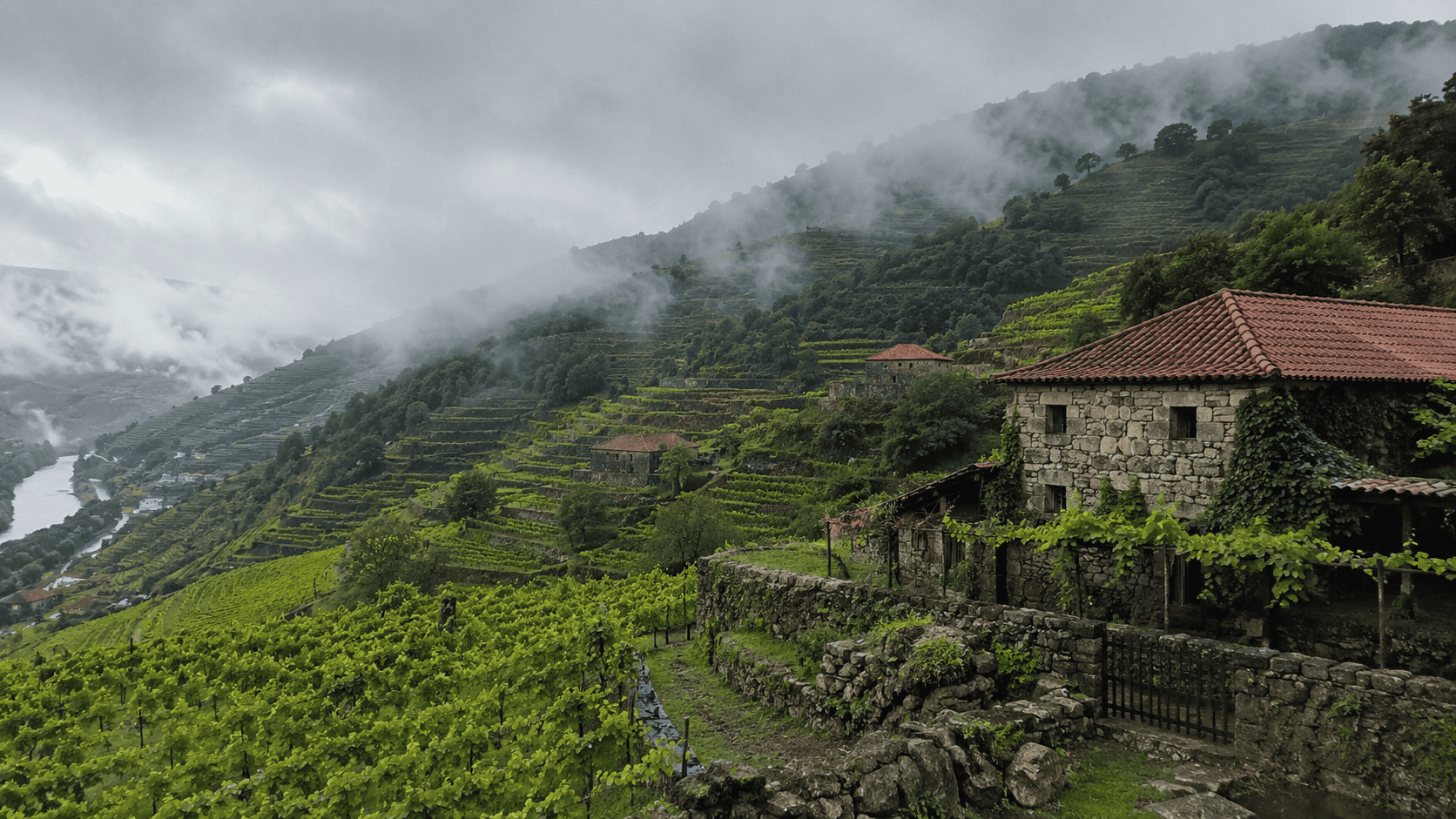
Countryside living in Portugal: a regional guide
Rural Portugal: four regions, four different lives
Ponte de Lima receives roughly three times the annual rainfall of the Alentejo coast. Both are rural Portugal. A buyer who researched one and bought in the other has made an expensive mistake, and it happens routinely.
The word “countryside” flattens a country that is far more varied than its size suggests. Rural Portugal runs from the green Atlantic north — cool, wet, dense, and closer in climate to Galicia or Ireland than to anything in a brochure — through the mountainous centre, to the dry open plain of the Alentejo and the scrubbed hills of the Algarve interior. The building stock differs, the price differs by a factor of three, the buyer base differs, and the winters are not remotely comparable.
Choosing between them is the actual decision. What follows separates them.
The four, compared
| Climate | Landscape | Typical stock | Price level | Buyer base | |
|---|---|---|---|---|---|
| The North (Minho, Douro) | Wet, cool, green; 1,200–1,500mm+ rainfall | Terraced valleys, vines, granite | Stone farmhouses, quintas, ruins | Low to moderate | 95% foreign at premium level, mainly British |
| The Centre (Beiras) | Cold winters, hot summers, snow at altitude | Mountains, schist villages, forest | Schist and granite village houses | Lowest in mainland Portugal | Mixed, mostly domestic |
| The Alentejo | Hot dry summers, mild wet winters; 450–550mm | Open plain, cork oak, olive | Whitewashed montes, herdades | Low inland, very high on the coast | Majority domestic inland |
| Algarve interior | Mediterranean, hot dry summers | Hills, citrus, cork, scrub | Rural villas, quintas, ruins | Moderate | Heavily British and Northern European |
The North: the Minho and the Douro
This is the Portugal most international buyers have not looked at, and the one where foreign concentration is highest.
The Minho runs from the Douro river north to the Spanish border. It is intensely green, densely cultivated, and built in granite — vines trained overhead on stone pergolas, terraced smallholdings, and farmhouses with external staircases and wooden balconies. It is also genuinely wet. Rainfall in the Minho and the Peneda-Gerês range is among the highest in Iberia, and winters are cold and damp rather than mild.
Ponte de Lima is the emblematic town: a medieval bridge over the Lima, arcaded streets, a fortnightly fair claimed as the oldest in Portugal, and a hinterland of quintas. Property ranges from ruins and rustic parcels through renovation projects to restored farmhouses on several thousand square metres, with a smaller luxury villa market above.
Viana do Castelo on the coast, Caminha at the mouth of the Minho facing Spain, Arcos de Valdevez and Ponte da Barca inland toward Gerês, and the cities of Braga and Guimarães complete the region.
The market data is striking. Engel & Völkers recorded Guimarães averaging €1,728 per square metre and Braga €1,704 in its 2025–2026 report, with growth of under 2% — modest by Portuguese standards. But 95% of premium housing transactions in the Minho were made by foreign buyers, predominantly British, and roughly 95% of transactions in the region completed without bank credit. That is the highest international concentration of any rural Portuguese market and a market functioning almost entirely on cash.
On American buyers specifically. There is genuine and growing American interest in the far north, actively promoted by US expatriate media, with Caminha, Viana do Castelo, and Ponte de Lima named repeatedly as the next discovery. The transaction data does not yet show it: the recorded premium base is British. Both things can be true, and an American buyer arriving in the Minho should understand that the established international community there is not primarily American, and that the region’s appeal in US publications is running ahead of its US transaction base.
The Douro, upriver from Porto, is a different proposition again — terraced schist slopes, Port and table wine quintas, and a UNESCO cultural landscape that constrains what may be built and altered. A Douro quinta is an agricultural and often hospitality business rather than a house with a view, and Port production is governed by an annual quota system tied to registered plots and their classification. Underwrite it as a business.
The Center of Portugal: the Beiras
The least expensive and least understood part of mainland Portugal.
The Serra da Estrela is the country’s highest range, with genuine snow, ski infrastructure, and schist villages at altitude. Covilhã and Fundão sit on its flanks, Fundão having attracted technology investment and a younger population than most interior towns. Castelo Branco and Idanha-a-Nova run south toward the Spanish border across a hot, dry, thinly populated plateau. Coimbra’s hinterland, the Bairrada wine country toward Aveiro, and the historic centre around Tomar complete the region.
Prices here are the lowest in mainland Portugal. So is the level of services, and the interior has experienced sustained depopulation — schools and health posts have closed across many freguesias, and the trend has not reversed.
Two warnings specific to the centre. Winters at altitude are cold in a way most buyers do not anticipate, and the housing stock is not built for it. And large parts of the interior carry serious wildfire exposure; the fires of 2017 and since have concentrated in this region. Insurance, access, defensible space around the building, and the state of surrounding forest are not optional diligence here.
The Alentejo
Covered in detail separately (click to visit), so briefly: the open plain, cork and holm oak montado, olive and vine, whitewashed montes and herdades, and the driest climate in the country at 450–550mm on the coast. It was Portugal’s fastest-appreciating region over the year to April 2026 at 21.3%, from a very low base.
The interior is majority-domestic, which insulates it from any single foreign economy. The coast around Comporta and Melides is a different market entirely, priced at multiples of the interior.
The Algarve interior
Twenty minutes north of the coast, and a different country.
São Brás de Alportel is the most practical option — a real town in the hills above Faro, cooler in summer, roughly twenty minutes to a hospital, with an established international community. Loulé’s hinterland, Silves, and Tavira’s interior offer citrus, cork, and rural villas. Monchique sits high in the west with 900–1,200mm of rainfall against 450–550mm on the coast, cooler and greener, and with the region’s most serious wildfire history. Alcoutim on the Guadiana is among the most remote municipalities in the country.
The Algarve interior buys you space, quiet, and lower prices while keeping the coast, an international airport, and hospital access within reach. Its buyer base is heavily British and Northern European, and English is widely spoken — which some buyers want and others specifically came to avoid.
The building stock problem
This applies everywhere and is the most consistently underestimated part of a rural purchase.
Traditional Portuguese rural construction is granite in the north, schist in the centre and Douro, and rendered masonry in the south. Almost none of it is insulated, and Portugal’s older housing stock performs poorly thermally. In the wet north, a stone house that has been closed for years will be damp, and drying and treating it is a project rather than a task.
Timber structural decay is the most common expensive discovery. Water ingress over decades attacks joist ends where they bear into masonry, and the damage is invisible until floors are opened. A survey that does not include opening up is not a survey.
Registry against reality. Extensions, outbuildings, and internal subdivisions carried out over a century may never have been registered. Any discrepancy between the caderneta predial, the land registry entry, and what physically stands becomes your problem at completion rather than the seller’s.
The habitation licence permits the building to be occupied. Its absence, or a licence that does not cover the current configuration, stops a sale or forces a retrospective legalisation that can take a year or more.
Services. Legal access rights over intervening land, water supply and abstraction licensing, electricity connection, and wastewater arrangements. Isolated rural properties frequently rely on boreholes and septic systems whose licensing needs verification.
Renovation costs. Construction costs rose 6.9% year on year in May 2026 with materials up 6.4%, and the sector carries an estimated shortage exceeding 90,000 workers. Rural renovation budgets built on figures from three years ago, or on northern European assumptions, will be wrong, and finding a reliable contractor in a thinly populated area takes longer than finding one in Lisbon.
Rustic land: the same trap everywhere
Portuguese land is classified urbano or rústico. Rustic land is protected for agricultural and forestry use and does not carry residential development rights as a matter of course.
Foreign buyers are routinely shown large rustic parcels at prices that look extraordinary — several hectares for less than a village house. The arithmetic only works if you can build. Listings in the north are frequently explicit that a parcel is “not buildable,” and buyers read past it.
The common workaround offered is a pre-existing registered ruin, on the basis that a ruin may be rebuilt. That route has narrowed considerably, and municipalities have become markedly less willing to interpret a collapsed wall as a dwelling. The National Ecological Reserve and National Agricultural Reserve overlay large areas independently of the municipal plan, and natural park designations — Peneda-Gerês, Serra da Estrela, Montesinho, Serra de São Mamede — carry their own restrictions.
The only reliable answer is a written viability opinion from the relevant câmara municipal, obtained before any deposit is committed. A seller’s assurance, an agent’s confidence, and a neighbouring house built under earlier rules are none of them evidence.
Liquidity, stated plainly
Rural property is the least liquid segment of the Portuguese market, and this is where the honest gap between rural and urban is widest.
Ordinary resale property nationally takes roughly 90 to 120 days. A well-priced apartment in Lisbon, Porto, Braga, Aveiro, or Faro can sell in 45 to 75. An overpriced villa, rural house, or renovation project can sit for more than 150 days, and in thin interior markets considerably longer than that.
The reasons compound. The buyer pool for a specific rural property is small. Much of the stock is heterogeneous, so comparable evidence is scarce and pricing is guesswork. Renovation projects appeal to a narrow group. And the further from a city or an airport, the smaller the pool becomes.
For a buyer this means two things. Rural Portugal should be bought for use over a long horizon, not for a resale in five years. And on the way in, the illiquidity is your friend — there is room to negotiate that does not exist in Lisbon.
Services, healthcare, and depopulation
Portugal’s interior has been losing population for decades. Schools, health posts, banks, and post offices have closed across many rural freguesias, and the pattern continues.
Practical consequences worth checking for any specific address: distance to a hospital rather than a health centre, distance to a supermarket and pharmacy, mobile and fibre coverage, whether the nearest town has year-round services or seasonal ones, and the condition and ownership of the access road.
Language matters more here than on the coast. English is widely spoken in the Algarve and in the international pockets of the Minho; it is not in most of the interior. For daily life — tradespeople, the câmara, the health centre, neighbours — functional Portuguese is closer to a requirement than an advantage.
Who is buying
The Minho’s premium segment is 95% foreign and predominantly British, buying villas with gardens and pools, overwhelmingly in cash.
The Algarve interior draws British and Northern European buyers alongside a domestic base.
The Alentejo interior and the Beiras are majority-domestic — Lisbon and Porto families buying weekend property, local buyers, and agricultural purchasers — with Dutch, German, British, and French buyers active in rural stock at price points unavailable elsewhere in Western Europe.
Nationally, growth rates in the first quarter of 2026 were highest not in the major cities but in secondary and rural regions, particularly the north and the Douro, as buyers priced out of urban markets looked further afield.
Choosing
You want green, dramatic landscape, and do not mind rain. The Minho or the Douro. Establish that you can tolerate a wet, cold winter in an uninsulated stone house before committing — and budget for insulation and heating properly.
You want the lowest possible entry price and the most land. The Beiras or the Alentejo interior. Accept limited services, depopulation, wildfire exposure in the centre, and very limited resale liquidity.
You want rural life with coastal and airport access retained. The Algarve interior, particularly São Brás de Alportel.
You want an agricultural business rather than a house. The Douro for wine, the Alentejo for cork, olive, and vine. Underwrite it as an operating business, including the quota, classification, and water rights.
You want to be near a functioning city. Braga, Guimarães, or the Coimbra hinterland put real urban infrastructure within thirty minutes of rural property.
You want resale liquidity. Not rural Portugal. Buy near a city or on the coast.
The most common error is choosing rural Portugal on a summer visit. Every one of these regions is at its best in June. The Minho in January, the Serra da Estrela in February, and an isolated Alentejo monte in the dark are all quite different experiences, and they are the ones that determine whether the purchase works.
How Luznur Capital works in rural markets
Establishing what can be built, before anything is committed. Land classification, REN and RAN overlays, natural park boundaries, and the municipal plan position confirmed in writing with the câmara. This single step invalidates more rural purchases than any other factor.
Comparable evidence where little exists. Rural stock is heterogeneous and portal pricing is unreliable. Establishing what genuinely comparable property has transacted at, including privately, is what determines whether a price is right.
Technical diligence proportionate to the risk. Structural survey including opening up on older stone buildings, registry reconciliation, habitation licence, access rights, water abstraction, and wastewater.
Renovation cost reality. Realistic budgets against current construction inflation and contractor availability in the specific area, rather than optimistic figures that make the arithmetic work on paper.
Honest advice on liquidity and season. Where a client’s horizon or requirements point away from rural property, saying so is the service.
FAQ
Is rural Portugal wet or dry?
Both, depending where. The Minho and Peneda-Gerês in the far north receive among the highest rainfall in Iberia, with cold damp winters, while the Alentejo records roughly 450–550mm on the coast. Monchique in the Algarve interior gets 900–1,200mm against 450–550mm on the coast below it. Rural Portugal spans a threefold difference in rainfall.
Where is Ponte de Lima and what is the market like?
Ponte de Lima is in the Minho, in Portugal’s far north, roughly an hour from Porto and close to the Spanish border. Property ranges from ruins and rustic parcels to restored stone farmhouses and a smaller luxury villa market. Engel & Völkers recorded 95% of premium transactions in the Minho going to foreign buyers, predominantly British, with around 95% of purchases completed without bank credit.
Are Americans buying in northern Portugal?
There is genuine and growing American interest in the Minho, actively promoted by US expatriate publications naming Caminha, Viana do Castelo, and Ponte de Lima. The recorded premium transaction base in the region is predominantly British rather than American, so US interest is currently running ahead of US transactions.
Which is the cheapest rural region in Portugal?
The Beiras and interior districts, with Portalegre in the Alto Alentejo recorded at a median near €970 per square metre — the lowest of any district. The trade-off is limited services, sustained depopulation, wildfire exposure in the centre, and very limited resale liquidity.
Can I build on rustic land in Portugal?
Generally no. Rustic land is protected for agricultural and forestry use and does not carry residential development rights. The pre-existing registered ruin route has narrowed considerably, and REN, RAN, and natural park designations may each restrict construction independently of the municipal plan. Obtain written viability confirmation from the municipality before committing funds.
How long does rural property take to sell in Portugal?
Longer than urban property. Ordinary resale nationally runs roughly 90 to 120 days and well-priced city apartments 45 to 75, but an overpriced villa, rural house, or renovation project can sit for more than 150 days, and considerably longer in thin interior markets. Rural property should be bought for long-horizon use rather than for resale.
What should I check before buying an old rural house?
Structural condition of timber floor and roof structures, with a survey that includes opening up; agreement between the land registry, tax record, and the building as it stands; a valid habitation licence covering the current configuration; legal access rights; water supply and abstraction licensing; and wastewater arrangements.
Do I need to speak Portuguese to live rurally?
In most of the interior, functional Portuguese is closer to a requirement than an advantage. English is widely spoken in the Algarve and in the international pockets of the Minho, but daily dealings with tradespeople, the municipality, and health services inland are conducted in Portuguese.
Is wildfire a real risk?
In parts of the country, yes. The central interior and the Serra de Monchique have significant fire history. Insurance availability and cost, access roads, defensible space around the building, and the condition of surrounding forest are material diligence items rather than afterthoughts in those areas.
Is this article investment advice?
No. It presents general market and regional information as of August 2026 and is not a recommendation regarding any property or region. Land classification, building rights, and licensing are property-specific and must be verified independently before any commitment.
DISCLAIMER
Important information
This article is provided for general information only and reflects publicly available market, regulatory, and climate information as of August 2026. It does not constitute investment, financial, tax, or legal advice, and is not a recommendation regarding any property or region.
Price and market data derive from published research including Engel & Völkers, Instituto Nacional de Estatística, and listing and market analysis platforms, which apply differing methodologies, coverage, and bases and are not directly comparable. Rural markets carry thin transaction volumes and highly heterogeneous stock, so published figures are less reliable than in liquid urban markets and are indicative rather than valuations. Days-on-market figures are estimates drawn from market commentary. Past price movements are not a guide to future performance.
Climate figures reflect typical patterns from published summaries rather than guarantees, and vary by altitude, aspect, and year. Land classification, construction viability, water abstraction rights, access, licensing, and wildfire exposure are specific to each property and municipality and must be verified independently. Nothing here should be relied upon as confirmation of what may be built or altered at any location.
Luznur Capital is a licensed real estate brokerage and advisory firm (AMI 22354). Independent legal, planning, technical, and insurance advice should be obtained before any acquisition.
SHORT TOP-OF-PAGE DISCLAIMER VARIANT
General information as of August 2026. Rural markets are thin and published price data is indicative, not valuation. Building rights, water, access, and wildfire exposure are property-specific and must be verified with the municipality. Not investment, tax, or legal advice. Luznur Capital (AMI 22354).
Considering rural Portugal
What can be built, what the winter is actually like, and how long the property would take to sell are the three questions that decide a rural purchase, and none of them is answerable from a listing.
Luznur Capital advises international buyers across rural and coastal Portugal, from the Minho and the Douro to the Alentejo and the Algarve interior, including off-market opportunities, with coordinated legal, planning, and technical partners.
To discuss a specific requirement, contact info@luznurcapital.com
Tag:
Category:
- Alentejo (1)
- Algarve (15)
- Almancil (5)
- Buyer Guides by Nationality (6)
- Buying in Portugal (22)
- Cascais (6)
- Comporta (6)
- Costs & Fees (2)
- Country Comparisons (3)
- D7 Visa (5)
- D8 Visa (4)
- Diplomacy (1)
- Eastern Algarve (3)
- Economy (9)
- Estoril (5)
- Foreign Bilateral Relations (3)
- GCC (2)
- GCC Investors Portugal (2)
- Golden Triangle Algarve (5)
- Golden Visa (1)
- Golden Visa Portugal (2)
- HNWIs (16)
- International Buyers (24)
- Investing in Portugal (29)
- Investment (6)
- Investment & Advisory (15)
- Investment & Structuring (1)
- Lisbon (5)
- Lisbon (11)
- Market Data (7)
- Market Guides (8)
- Porto (6)
- Portugal (16)
- Quinta da Marinha (6)
- Quinta do Lago (11)
- Real Estate Portugal (32)
- Relocating to Portugal (14)
- Relocation (1)
- Residency & Investment (2)
- Sotavento Algarve (3)
- Tavira (7)
- Tourism (4)
- Vale do Lobo (5)
- Vila Real de Santo António (1)
- Vilamoura (5)
- Wealth Management (1)
- Wealth Management Portugal (4)