 (+351) 932 224 792
  info@luznurcapital.com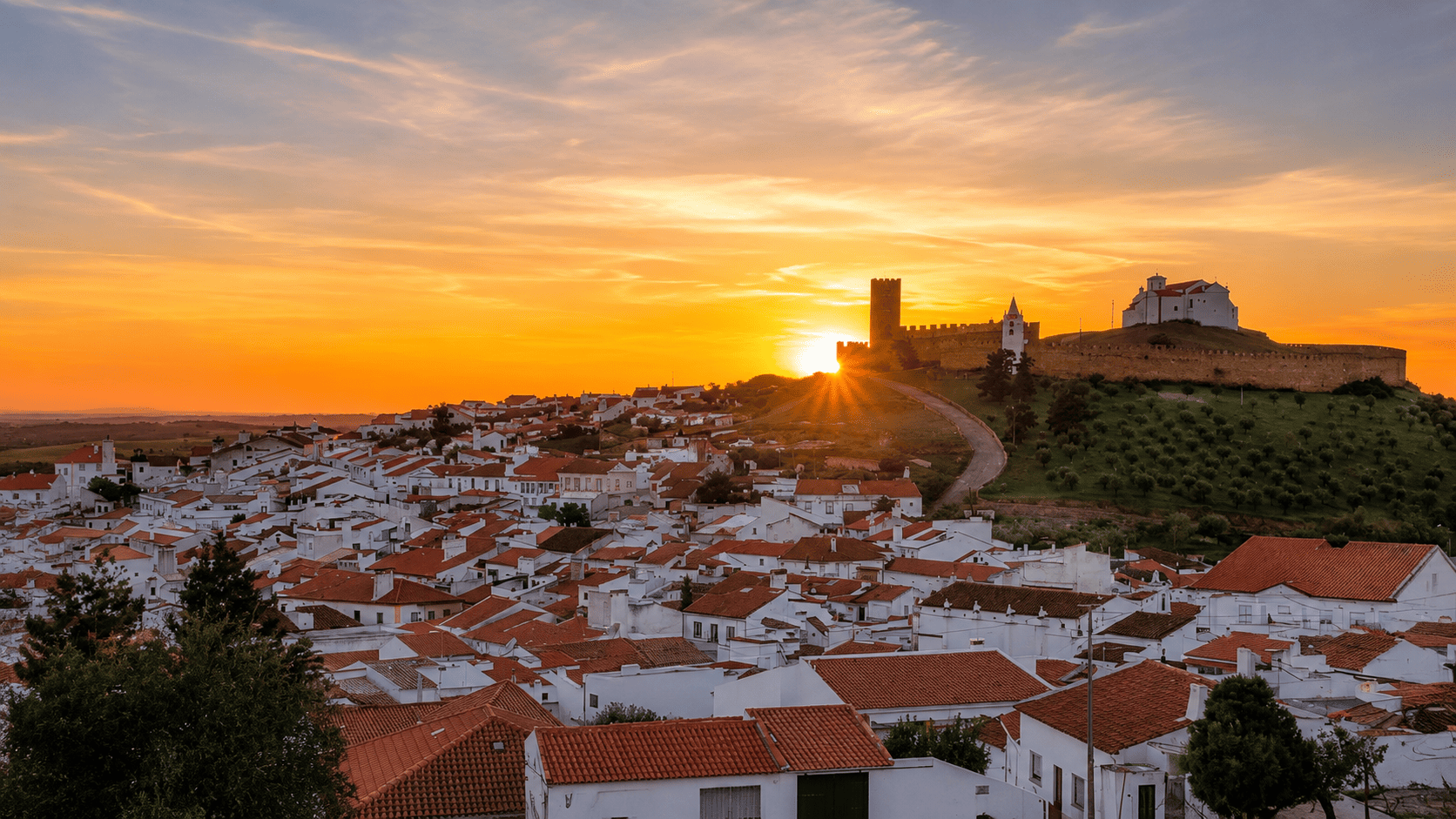
Investing in the Alentejo: property, land, and hospitality
The Alentejo was the fastest-appreciating region in Portugal over the year to April 2026, rising 21.3% on idealista’s index — ahead of the Azores at 19.3%, the Centro at 12%, and the Lisbon metropolitan area at 11.1%. The national figure was 10.8%.
That number conceals more than it reveals. Beja, among the cheapest district capitals in the country, rose 23%. Évora, the region’s cultural and commercial centre, rose 7.5%. A cork estate outside Mértola and a beach house in Comporta are both technically Alentejo property, and they have nothing whatever in common as investments.
The region covers roughly a third of Portugal’s land area and holds around 5% of its population. It contains four distinct markets that move at different speeds, for different reasons, driven by different buyers. Treating it as one is the most common and most expensive error made here.
What the Alentejo actually is
Open plain, mostly. Wheat and barley on undulating ground, punctuated by cork oak and holm oak montado — a managed savannah system that is among the oldest continuous agricultural landscapes in Europe. Olive groves, increasingly intensive. Vineyards. Whitewashed villages with blue or yellow trim, marble in the east, schist in the south. Very few people, very little noise, and a horizon that goes further than anywhere else in the country.
The character is austere rather than picturesque, and that is precisely its appeal to the buyers who come here. It is hot and dry in summer — inland temperatures regularly exceed 40°C in July and August — cold and wet in winter, and empty year-round. Distances are long, and the roads are good and almost unused.
Lisbon is between one and two and a half hours by car from most of the region. The A2 highway runs south through the western Alentejo toward the Algarve; the A6 highway runs east from Lisbon through Évora to the Spanish border at Elvas and on toward Badajoz and Madrid.
The economy is agriculture, cork, wine, marble, and — increasingly — tourism. Sines on the coast is a major industrial port and petrochemical complex, with a datacenter project and it is not a lifestyle destination.
Alentejo Litoral: the coast
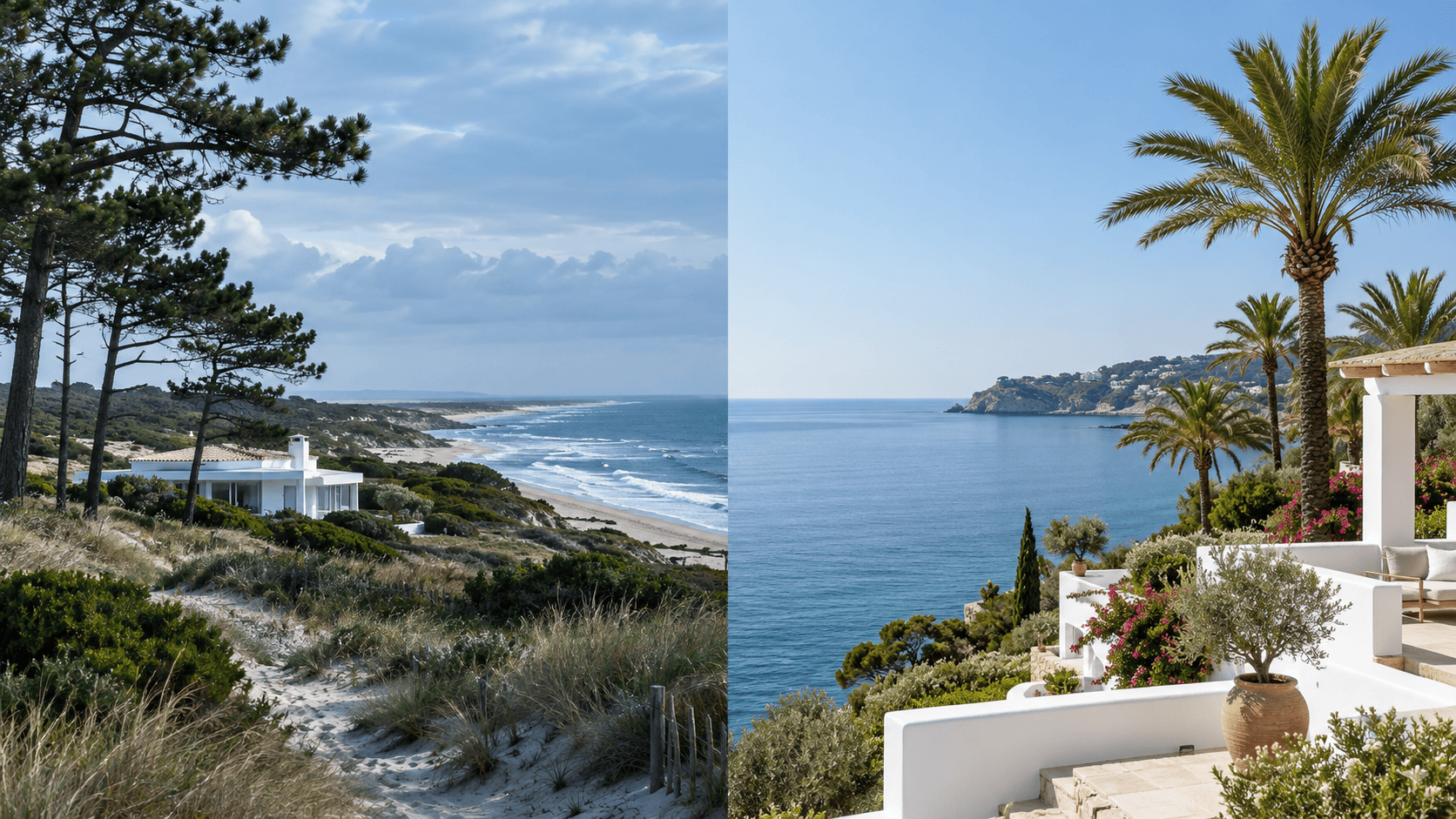
The most expensive and most internationally driven part of the region, and the only part where prices approach those of the Algarve.
INE recorded a median transaction price of €2,128 per square meter across Alentejo Litoral in the third quarter of 2025, above the national median of €2,111 — the only Alentejo sub-region above the national figure. Prime coastal pockets trade at multiples of that.
Comporta and Melides anchor the top of the market. Prime Comporta property has been recorded between roughly €6,800 and €10,700 per square meter, three to five times the national median, driven by seven decades of ownership concentration and nature reserve density caps. Melides has generally run 15% to 25% below. Both are covered in detail separately, because the buying mechanics there differ substantially from the rest of the region.
Carvalhal, Brejos da Carregueira, Muda, and Torre form the surrounding village and estate market, with a substantial approved development pipeline behind them.
Tróia, at the peninsula’s northern tip and reached by ferry from Setúbal or by road around the Sado estuary, is a resort market rather than a scarcity market: predominantly apartments and low-rise product around a Robert Trent Jones Sr golf course and a marina, at entry points far below Comporta’s.
Grândola and Santiago do Cacém sit inland of the coast and offer the estate and herdade market at materially lower prices than the beach strip, within twenty to thirty minutes of it.
Porto Covo, Vila Nova de Milfontes, Almograve, and Zambujeira do Mar run south into the Parque Natural do Sudoeste Alentejano e Costa Vicentina. This is a completely different coast: high cliffs, wild Atlantic, surf, and a natural park regime that constrains development severely. Vila Nova de Milfontes, where the Mira estuary meets the ocean, is the largest and most developed of these and functions as the base for the southwestern coast. Pricing sits well below Comporta, and the buyer profile is younger, more Portuguese, and more oriented to surf and nature than to design.
Odemira, the largest municipality in Portugal by area, extends inland from that coast and contains both intensive horticulture and very cheap rural land.
The natural park designation across much of this southern coast is the defining constraint. Construction is heavily restricted, and buyers shown attractive coastal parcels here should assume the answer is no until a municipality confirms otherwise in writing.
Alentejo Central: Évora and the estate country
The cultural and commercial heart of the region, and the strongest market for the classic Alentejo purchase — a herdade or monte with land.
Évora is a UNESCO World Heritage city with a Roman temple, a walled historic centre, and a university dating to the sixteenth century. Asking-price indices have placed Évora city near €2,556 per square meter, with growth of 7.5% over the year to April 2026 — modest by regional standards, which reflects a market that repriced earlier rather than one that is stalling. Average sale prices have been reported around €289,000 and rentals near €1,200 per month. Supply of large properties inside the walls is genuinely scarce, and the periphery offers what the walls cannot: land, privacy, and open views.
Reguengos de Monsaraz, Monsaraz, Alandroal, and Mourão run east toward the Spanish border and the Alqueva lake. Monsaraz itself is a walled hilltop village above the water, and the surrounding area has become the region’s most established rural luxury hospitality cluster.
Estremoz, Borba, and Vila Viçosa form the marble triangle in the north-east — working quarries, ducal palaces, and a built vernacular in white marble that exists nowhere else in Portugal.
Arraiolos, Montemor-o-Novo, and Redondo sit between Évora and Lisbon, and Montemor in particular benefits from being roughly an hour from the capital, which puts it within weekend range in a way that Beja is not.
This is where most of the significant herdade transactions happen. A quinta near Évora with Alqueva views was listed at €4.9 million during 2026, which is toward the upper end of the openly marketed inventory.
Alto Alentejo: the least expensive market in Portugal
The northern strip, running from the Tagus to the Spanish border, and the cheapest part of mainland Portugal by a clear margin.
Portalegre district has been recorded at a median of around €970 per square meter — the lowest of any district in the country. That figure sits against a national median above €3,000 on asking indices.
Marvão and Castelo de Vide are fortified hill towns in the Serra de São Mamede natural park, at genuine altitude, with a climate and landscape that has more in common with northern Spain than with the plain below. Marvão in particular is among the most striking villages in Portugal and has attracted boutique hospitality investment.
Elvas is a second UNESCO site, a garrison town with the largest bulwarked dry-ditch fortifications in the world, fifteen minutes from Badajoz in Spain.
Alter do Chão holds the national stud, and the region is the centre of Lusitano horse breeding — a genuine niche market with its own international buyer base.
Nisa, Crato, and Ponte de Sor complete the picture, with Ponte de Sor benefiting from an aerodrome that has attracted aeronautical industry.
Alto Alentejo offers the largest properties for the least money in Portugal. It also has the smallest local economy, the thinnest services, and the longest run to Lisbon of any Alentejo sub-region. Resale liquidity is correspondingly limited, and anyone buying here should assume a long hold.
Baixo Alentejo: the fastest-moving numbers
The southern interior, running down toward the Algarve.
Beja, the district capital, recorded a 23% annual increase to April 2026 — one of the largest in the country — from a median of around €1,439 per square meter. Average sale prices have been reported near €105,000, which puts the scale of the market in perspective: this is a growth rate applied to a very low base, and it should not be read as a signal comparable to the same percentage in Lisbon.
Serpa, Moura, and Vidigueira sit east toward Alqueva, with cheese, wine, and olive production.
Mértola in the far south is a hilltop town above the Guadiana, with visible Islamic-period heritage and one of the most intact medieval urban forms in Portugal. It is roughly ninety minutes from the Algarve coast.
Castro Verde and Ourique hold the open cereal plain and its protected steppe bird habitat, which carries its own planning implications.
The Baixo Alentejo has benefited most from the Alqueva irrigation system, which converted large areas of dry cereal ground into irrigated olive and almond production over the past two decades. That transformation is the underlying driver of agricultural land values here, and it is not finished.
Buying a herdade: what you are actually acquiring
The classic Alentejo purchase is an estate — a herdade or, at smaller scale, a monte — and it is a composite asset rather than a house with land.
Land classification determines everything. Portuguese land is either urbano or rústico, and rustic land does not carry residential development rights as a matter of course. The common route presented to buyers is a pre-existing registered ruin, on the basis that a ruin may be rebuilt. That route has narrowed considerably, and municipalities have become markedly less willing to interpret a collapsed wall as a dwelling. The National Ecological Reserve and National Agricultural Reserve — REN and RAN — overlay large areas independently of the municipal plan and can prohibit construction on land that appears clear under every other instrument.
The only reliable answer is a written viability opinion from the relevant câmara municipal, obtained before any deposit is committed. A seller’s assurance and a neighbour’s existing house are not evidence.
Water is the constraint that decides value. The Alentejo is water-stressed and getting more so. Irrigation depends on licensed abstraction, whether from boreholes, watercourses, or the Alqueva network, and those licences have specific volumes, conditions, and renewal terms. An estate with irrigation rights and an estate without them are different assets at the same hectarage. Confirm what exists, what it permits, and what it costs.
Agricultural production is a business. Cork is harvested on a nine-year cycle and generates income only in harvest years, from trees that take twenty-five years to reach first extraction. Olive groves differ enormously between traditional and intensive plantings, in both yield and capital requirement. Vineyards carry replanting rights, DOC classification, and the question of whether fruit is sold or vinified. None of this is passive.
Also confirm: legal access rights over intervening land, electricity and water connections, wastewater licensing for isolated properties, hunting rights and whether they have been let to a third party, boundary agreement between the registry and physical reality, and the existence of any tenancy or arrendamento rural over the land.
Hospitality: the strongest pipeline in the region’s history
The Alentejo is in the middle of a hotel investment wave, and the composition tells you where the market is going.
Six luxury openings were scheduled across the region during 2026 alone, spread between the coast and the deep interior, with further projects running into 2027.
On the coast, Sublime Comporta Villas opened in May 2026, extending the existing hotel with private villas. Ando Living Comporta House followed in July with sixteen contemporary villas. Quinta Amala at Melides is a boutique project among the pines.
In the interior, Anantara Royal Vila Viçosa converts a sixteenth-century convent into a 76-room resort. Hotel Santo André Évora by Wot Signature opened 27 rooms in Évora’s historic centre. Wotels opened Dom Nuno inside the walls at Monsaraz in June 2026, following the reopening of Hotel Horta da Moura. Torre Vã brings a project to Ourique in the Baixo Alentejo.
The largest is still ahead. Herdade da Palheta, between Évora and Redondo, is a reported €110 million development comprising a 60-room hotel, 35 villas, and 20 country houses, with a wine club and planned production of 125,000 bottles annually, targeted for 2028.
Two observations follow.
The interior is now attracting international operators and capital at scale, which it was not five years ago. Anantara at Vila Viçosa and a nine-figure project outside Évora are qualitatively different from the family-run rural tourism that has historically defined the region.
And the model has settled: heritage conversion or estate development, small room counts, food and wine at the centre, wellness and nature as the programme. São Lourenço do Barrocal at Monsaraz established the template and the market has followed it.
For an investor, the implication is that the Alentejo hospitality opportunity is now an operating-business opportunity with an identified format, rather than a first-mover land play. Underwrite it as a business — operator, occupancy, seasonality, staffing in a region with a small labour pool — not as a property.
Short-term rental
Rural and coastal Alentejo sit in a different regulatory position from Lisbon and Porto, and the difference matters.
Portuguese short-term letting operates through Alojamento Local registration, regulated at municipal level. Containment zones — where new registrations are restricted or prohibited — have been applied in dense urban areas and in parts of the Algarve. Most of the Alentejo interior is not in that position, and registration remains available.
Two developments deserve attention. Municipalities with more than 1,000 registered units must adopt or revise their regulations by 31 December 2026, and may extend a suspension on new registrations once during that period. And EU Regulation 2024/1028 came fully into force in May 2026, requiring booking platforms to verify national registration numbers before publishing a listing.
Tourism-licensed accommodation — empreendimento turístico, rural tourism, agritourism — operates under a different regime entirely from a residential property registered for AL, with different requirements and different treatment. For an estate intended to generate income, the licensing route should be decided before purchase, because it affects what can be built and how.
Seasonality is the harder constraint. Coastal Alentejo concentrates demand into July and August, and Comporta outside those months is very quiet. The interior spreads more evenly across spring and autumn and empties in high summer, when inland heat pushes visitors to the coast. A yield model built on peak weekly rates and annualised will be wrong by a wide margin in either case. Model the actual lettable weeks.
Wine, Alqueva, and the dark sky
Three assets that shape the region’s investment case and are frequently overlooked.
Alentejo wine is a genuine industry rather than a hobby sector, with the DOC covering eight sub-regions and a substantial export base. Enoturismo — the combination of production, tasting, restaurant, and accommodation on a single estate — is the established commercial model, and it converts an agricultural holding into a hospitality business with a differentiated product.
Alqueva is the largest artificial lake in Western Europe, created in 2002, and it changed the eastern Alentejo. It provides the irrigation base that transformed Baixo Alentejo agriculture, and it created a 1,160-kilometre shoreline with waterfront property, houseboats, and lake tourism where none existed.
The Dark Sky Alqueva reserve is a certified low-light-pollution zone, the first of its kind in the world to receive that designation, and it has produced a genuine astrotourism sector. For a rural hospitality asset in the Monsaraz, Mourão, or Reguengos area, it is a real and defensible differentiator rather than a marketing line.
Who buys here
The Alentejo’s buyer composition differs sharply from the Algarve or Cascais, and the difference is a stability feature rather than a limitation.
The interior is majority-domestic. Unlike Quinta do Lago at roughly 80% international ownership or Cascais at 81.3%, most Alentejo interior transactions involve Portuguese buyers — Lisbon families buying weekend estates, local buyers, and agricultural purchasers. That base does not disappear when a foreign currency weakens or another country changes its tax rules.
The coast is internationally driven. Comporta and Melides attract French, Swiss, Belgian, and Portuguese buyers with a design-led and privacy-driven profile. The southwestern coast around Milfontes and Zambujeira draws a more Portuguese and younger profile, with German and Dutch presence.
The interior’s international buyers are predominantly Dutch, German, British, and French, typically buying land and rural property at price points unavailable elsewhere in Western Europe, and increasingly Americans as the Portuguese market has entered their consideration set.
Institutional and development capital has arrived at the top end, concentrated in the coastal schemes and now in interior hospitality.
Nationally, purchases by foreign families resident outside Portugal fell 14.1% in 2025 even as the overall market hit records. A market with a substantial domestic base is better insulated from that than one without.
What this region suits, and what it does not
It suits a buyer who wants land, space, and privacy at prices that no comparable Western European market offers; who is buying for use over a long horizon rather than for liquidity; who is prepared to run an operating business if income is the objective; and who values emptiness over amenity.
It suits poorly a buyer who needs resale liquidity, who wants a walkable town functioning year-round with full services, who requires meaningful passive rental yield, or who is buying rustic land on the assumption that permission follows purchase.
The 21.3% regional appreciation figure is real and it is also the product of a very low base and a small number of transactions. Beja rising 23% from €1,439 per square meter and Lisbon rising 11% from €6,109 are not comparable events, and treating the former as evidence of a coming boom misreads what is happening. The Alentejo is being discovered, priced, and developed — steadily, from a long way behind, with a long way still to go.
How Luznur Capital works in the Alentejo
The Alentejo rewards local knowledge more than any other Portuguese region, because the binding constraints are invisible from a listing and vary parcel by parcel.
Establishing what can actually be built. Before a deposit is committed, the land classification, REN and RAN overlays, natural park boundaries, and municipal plan position are confirmed in writing with the relevant câmara. This single step invalidates more Alentejo purchases than every other factor combined, and it is the work that should happen first.
Water and agricultural diligence. Abstraction licences, their volumes and conditions, the state of the montado or grove, replanting rights, tenancies, and hunting rights. On an estate purchase these determine value more than the house does.
Off-market access. A substantial share of the better Alentejo estate inventory never reaches a portal, transacting privately between families, agricultural owners, and their advisors. Sourcing against a defined mandate produces a different shortlist than a public search.
Hospitality and development mandates. For investors approaching the region as an operating opportunity, the work spans site identification, licensing route, operator introduction, and the capital structure — with the understanding that a rural hotel is a business rather than a building.
Coordination. Portuguese legal, planning, tax, and technical partners work alongside clients’ existing advisors, so the planning position, acquisition structure, and licensing route are settled together rather than discovered in sequence.
FAQ
Is the Alentejo a good property investment?
It was Portugal’s fastest-appreciating region over the year to April 2026, rising 21.3% against a national figure of 10.8%. That growth comes from a very low base and a thin transaction market, so it should not be read as comparable to the same percentage in Lisbon. The region suits long-horizon buyers wanting land and space rather than those needing liquidity or passive yield.
How much does property cost in the Alentejo?
Around €2,050 per square meter on average across the region on asking indices as of April 2026, against a national figure above €3,100. Within that, Portalegre district has been recorded near €970 per square meter, Beja near €1,439, Évora city near €2,556, and prime Comporta between roughly €6,800 and €10,700. Asking prices typically run well above transaction prices, so the two should not be compared directly.
Which part of the Alentejo is most expensive?
The coast. Alentejo Litoral recorded a median transaction price of €2,128 per square meter in the third quarter of 2025, the only Alentejo sub-region above the national median. Within it, Comporta and Melides trade at multiples of the regional average.
Can I build a house on rustic land in the Alentejo?
Generally no. Rustic land is protected for agricultural and forestry use and does not carry residential development rights. The exception involving a pre-existing registered ruin has narrowed considerably. REN and RAN overlays, natural park designations, and the maritime public domain may each impose further restrictions independently of the municipal plan. Obtain written viability confirmation from the municipality before committing funds.
What is a herdade?
A large Alentejo estate, typically combining agricultural land — cork montado, olive groves, vineyard, or cereal — with one or more buildings. It is a composite asset rather than a house with a garden, and its value depends heavily on land classification, water abstraction rights, the state of the agricultural holding, access, and any tenancies or hunting rights over the land.
Are there new hotels opening in the Alentejo?
Yes, in significant numbers. Six luxury openings were scheduled across 2026, including Anantara Royal Vila Viçosa in a converted sixteenth-century convent, Hotel Santo André in Évora, Dom Nuno within the walls at Monsaraz, and Sublime Comporta Villas and Ando Living on the coast. Herdade da Palheta near Évora, a reported €110 million project with a hotel, villas, and a wine operation, is targeted for 2028.
Can I run a short-term rental in the Alentejo?
In most of the region, yes. Containment zones restricting new Alojamento Local registrations have been applied in dense urban areas and parts of the Algarve rather than across rural Alentejo. Municipalities with more than 1,000 registrations must revise their regulations by the end of 2026, and tourism-licensed accommodation operates under a separate regime from residential AL. Confirm the position for the specific property and municipality.
Who buys property in the Alentejo?
The interior is majority-domestic — Lisbon families, local buyers, and agricultural purchasers — with Dutch, German, British, and French buyers active in rural property, and growing American interest. The coast is more internationally driven, with French, Swiss, Belgian, and Portuguese buyers concentrated in Comporta and Melides. That domestic base makes the region less exposed to any single foreign economy than the Algarve or Cascais.
How far is the Alentejo from Lisbon?
Between roughly one and two and a half hours by car for most of the region. Montemor-o-Novo and Comporta are within about an hour, Évora around ninety minutes, and Beja, Mértola, and the far northeast considerably further. The A2 runs south through the western Alentejo and the A6 east through Évora to the Spanish border.
Is this article investment advice?
No. It presents general market information as of August 2026 and is not a recommendation regarding any property, region, or transaction. Land classification, construction viability, water rights, and licensing are property-specific and must be verified independently before any commitment.
DISCLAIMER
Important information
This article is provided for general information only and reflects publicly available market and regulatory information as of August 2026. It does not constitute investment, financial, tax, or legal advice, and is not a recommendation regarding any property, development, or transaction.
Price figures derive from a mix of sources including INE transaction data and idealista asking-price indices, which measure different things. Asking prices in Portugal have run substantially above median transaction prices, and figures from different sources are not directly comparable. Sub-regional figures reflect small transaction volumes in several cases, and percentage growth from a low base should not be equated with the same percentage in a large, liquid market. Past price movements are not a guide to future performance.
Land classification, construction viability, development rights, water abstraction licensing, agricultural tenancies, hunting rights, and licensing for tourism or short-term letting are specific to each property and each municipality, and are subject to change. Nothing here should be relied upon as confirmation of what may be built, irrigated, altered, or let at any particular location. Details of announced development and hospitality projects reflect information published by developers, operators, and regional tourism authorities and may not reflect current plans, approvals, or timelines.
Luznur Capital is a licensed real estate brokerage and advisory firm (AMI 22354). Independent legal, planning, agricultural, and technical advice should be obtained before any acquisition.
General market information as of August 2026. Price data combines transaction and asking-price sources that are not directly comparable, and several sub-regions have thin transaction volumes. Land classification, water rights, and building permissions are property-specific and must be verified with the municipality. Not investment, tax, or legal advice. Luznur Capital (AMI 22354).
Looking at the Alentejo
What can be built, what can be irrigated, and what can be let are the three questions that decide an Alentejo purchase, and none of them is answerable from a listing. Luznur Capital advises international buyers and investors across the coast and the interior — Comporta, Melides, Tróia, Grândola, Évora, Monsaraz, and the wider region — on residential acquisitions, estates, and hospitality mandates, including off-market opportunities, with coordinated legal, planning, and tax partners.
To discuss a specific mandate, contact info@luznurcapital.com
Tag:
Category:
- Alentejo (1)
- Algarve (15)
- Almancil (5)
- Buyer Guides by Nationality (5)
- Buying in Portugal (21)
- Cascais (6)
- Comporta (6)
- Costs & Fees (2)
- Country Comparisons (3)
- D7 Visa (5)
- D8 Visa (4)
- Diplomacy (1)
- Eastern Algarve (3)
- Economy (9)
- Estoril (5)
- Foreign Bilateral Relations (3)
- GCC (2)
- GCC Investors Portugal (2)
- Golden Triangle Algarve (5)
- Golden Visa (1)
- Golden Visa Portugal (2)
- HNWIs (16)
- International Buyers (24)
- Investing in Portugal (29)
- Investment (6)
- Investment & Advisory (14)
- Investment & Structuring (1)
- Lisbon (11)
- Lisbon (5)
- Market Data (6)
- Market Guides (8)
- Porto (6)
- Portugal (16)
- Quinta da Marinha (6)
- Quinta do Lago (11)
- Real Estate Portugal (32)
- Relocating to Portugal (14)
- Relocation (1)
- Residency & Investment (2)
- Sotavento Algarve (3)
- Tavira (7)
- Tourism (4)
- Vale do Lobo (5)
- Vila Real de Santo António (1)
- Vilamoura (5)
- Wealth Management (1)
- Wealth Management Portugal (4)