 (+351) 932 224 792
  info@luznurcapital.com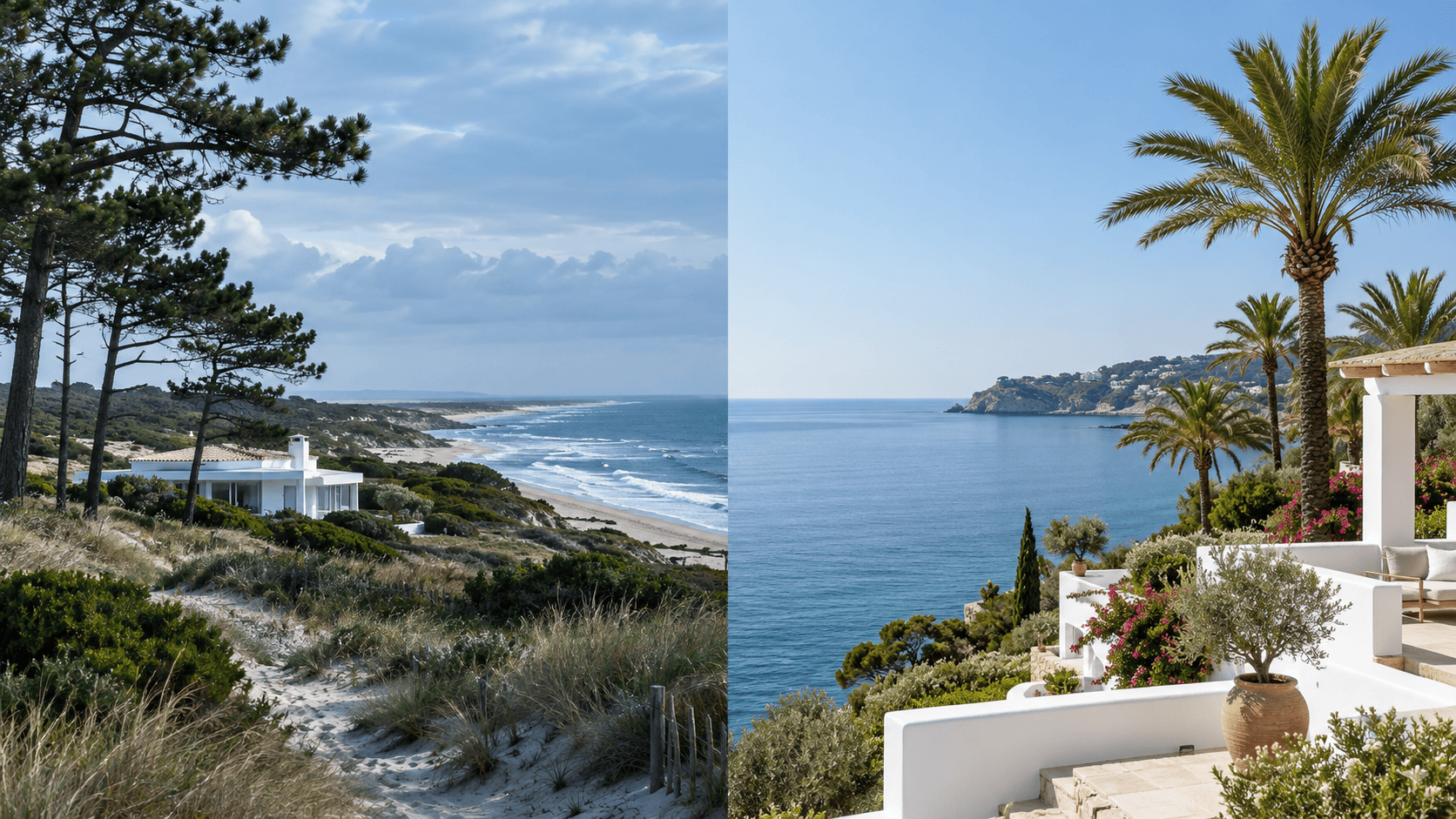
Cascais vs Marbella for international buyers
Cascais competes on the week. Marbella competes on the season.
These two markets are frequently compared and rarely compared well, because the obvious axis — price — is where they differ least.
Marbella’s average asking price entered 2026 at roughly €5,500 to €5,600 per square meter. Cascais sits between €4,713 and €5,591 depending on the source. At prime level, current listings in Quinta da Marinha run from around €11,300 to over €20,700 per square meter, against €6,000 to €18,000 for Marbella’s Golden Mile and Sierra Blanca.
Portuguese prime is not the discount option. On the best stock it is the more expensive of the two.
What separates them is everything else: whether the town functions in February, whether residency is available, what the asset costs to hold and pass on, and whether there is a market above €20 million.
The pricing, properly compared
Cascais. Market-wide averages run €4,713 to €5,591 per square meter depending on methodology. Prime areas — Quinta da Marinha, Birre, Gandarinha, Monte Estoril — are typically quoted at €6,000 to €8,000, with genuinely exclusive stock above €10,000.
Current listing evidence sits higher than those averages suggest. Detached houses in Quinta da Marinha are advertised from roughly €11,300 to €20,700 per square meter, with asking prices spanning €1.65 million for a small semi-detached property to €19.9 million for a 982 square meter villa. Rua Birre carries an average house price near €3.93 million, placing it among the most expensive streets in Portugal.
Cascais has recorded roughly 12% annual appreciation, with gross rental yields around 3.8%.
Marbella. Average asking prices near €5,500 to €5,600, up 9% to 10% year on year. The Golden Mile and Sierra Blanca run from about €6,000 to over €18,000. Puerto Banús sits between €5,000 and €12,000, Nueva Andalucía between €4,000 and €9,000, and Estepona between €3,000 and €7,000.
Above that sits a tier Cascais does not have. La Zagaleta exceeds €25,000 per square meter, with roughly two hundred plots, entry rarely below €5 million, and most activity between €10 million and €30 million. Golden Mile beachfront has reached €30,000.
The pattern, stated plainly. At the broad market level the two are comparable, with Marbella marginally ahead. At conventional prime they are level, with the best Cascais villa stock arguably above Marbella’s equivalent. Above €20 million, Marbella has a functioning market and Cascais does not.
A caution on all of it: these figures combine asking-price indices, agency estimates, and live listings using different methodologies across two countries. They indicate relative position, not valuation.
What each place actually is
This is where the comparison becomes useful.
Cascais is a town with a resort attached. It has a year-round resident population, a working center, a Portuguese population alongside the international one, and most of Portugal’s international schooling concentrated in one corridor. It is twenty-five minutes from Lisbon airport, which puts a capital city with 144 international destinations inside a short drive. Savills placed Cascais 23rd in EMEA in its 2026 next-generation wealth hubs index — the only Portuguese entry besides Lisbon itself, which Monocle separately ranked third in the world for quality of life this year.
Cascais is 81.3% foreign by acquisition, with Brazilian, Russian, and American buyers leading.
Marbella is a resort with a town attached. Larger, with deeper luxury infrastructure, far more international retail and hospitality, a longer-established high-end market, and greater transaction volume. Its season runs longer and its summer is more reliable.
The climate difference is real and it drives the behavioral one. Cascais faces the Atlantic. The water is cooler, the wind is a feature — Guincho is a windsurfing destination for a reason — and summers are moderated rather than intense. Marbella faces the Mediterranean, sheltered by the Sierra Blanca, with warmer water and a more dependable summer.
So the question is not which is better. It is whether you want the week or the season.
A family living in Portugal year-round gets a functioning town, a school run, a capital city in half an hour, and neighbors who are there in January.
A family visiting for the season gets more sun, warmer water, more to do, and a market with greater depth at the top.
Tax, where Andalusia is better than Spain’s reputation
The usual Portugal-versus-Spain tax argument is weaker for Marbella than for most of Spain, and it is worth being accurate about that.
Wealth tax. Portugal has no general wealth tax; AIMI applies only to Portuguese residential property above €600,000 per person, assessed on tax-assessed value rather than market value. Andalusia has abolished its regional wealth tax, so a Marbella resident pays none at regional level either.
But the national Solidarity Tax on Large Fortunes applies above €3 million at 1.7% to 3.5%, and regional relief cannot eliminate it. An Andalusian resident paying no regional wealth tax pays the Solidarity Tax in full. Portugal has no equivalent at any level.
Succession. Portugal levies no inheritance tax, with transfers to a spouse, descendants, and ascendants exempt. Andalusia offers near-total relief for direct-line heirs. On this axis the two are genuinely close — though Portugal’s position applies nationally while Andalusia’s depends on remaining in that community.
Acquisition. Andalusia applies ITP at 7% on resale. Portugal applies a flat 7.5% IMT to buyers who are not Portuguese tax residents from 1 September 2026, with no exemptions, plus 0.8% stamp duty. Broadly comparable, with Portugal’s non-resident rate newly raised.
Where Spain is clearly worse. It imputes income on non-rented property owned by non-residents, calculated from cadastral value — an empty Marbella villa generates an annual tax bill on income it never earned, and Portugal has no equivalent. And non-resident landlords outside the EU and EEA are taxed at 24% on gross rental income with no deductions, against 19% on net for EU residents. Post-Brexit that captures British owners, along with American, Gulf, and Swiss ones. Portugal taxes non-resident residential lettings at a flat 25% on net.
Residency, where the gap is absolute
Spain closed residency by investment entirely on 3 April 2025. Organic Law 1/2025 emptied the provisions governing the investor route. Buying in Marbella now confers nothing beyond the property.
Portugal’s route remains open, though property stopped qualifying in October 2023. Qualifying investments are CMVM-regulated funds at €500,000, cultural heritage donation, capital transfer, business creation, and research investment — with a presence requirement averaging seven days per year, the lowest in Europe.
For a non-EU buyer who wants a European foothold alongside the house, only one of these markets offers it. That is not a difference of degree.
One counterweight. Spain grants citizenship after two years of legal residence to nationals of Ibero-American countries, Andorra, the Philippines, Equatorial Guinea, and Portugal, and to Sephardic Jews. Portugal requires seven years for Portuguese-speaking nationals and ten for everyone else following Organic Law No. 1/2026. For a Latin American buyer that inverts the comparison entirely — though they would need a residency route other than investment to begin the clock.
Schooling, which decides it for families
Cascais holds the densest concentration of international schooling in Portugal, with British, American, French, German, and international-curriculum options across the Carcavelos, Estoril, Cascais, and Linhó corridor. For a family relocating with school-age children, that corridor is effectively the answer to the location question before price is discussed.
Marbella and the wider Costa del Sol have international schooling, including established British and international options, though the concentration is less dense and distances between home, school, and services are generally longer.
If children are part of the plan, the school decision should precede the property decision in both markets — and it narrows Cascais to a handful of neighborhoods far faster than budget does.
Connectivity
Cascais is twenty-five minutes from Lisbon airport, which serves 144 international destinations with particular depth on transatlantic and African routes — a structural advantage for North and South American owners.
Marbella is roughly 45 to 60 minutes from Málaga, which carries more routes overall with stronger European coverage, though less transatlantic depth.
For a European owner flying in frequently, Málaga’s route density generally wins. For a North or South American owner, Lisbon’s transatlantic position is the stronger asset. For anyone, Cascais’s shorter transfer is worth something on every single journey.
Liquidity and the buyer pool
Marbella is the larger and more liquid market, with more transactions, more inventory, more agents, and a longer record of trading through cycles. That matters most on exit, which is when buyers discover it.
Cascais is smaller but not thin, supported by a buyer base that includes Portuguese purchasers alongside the 81.3% international share, and by proximity to a capital city economy. Its international composition — Brazilian, Russian, and American rather than overwhelmingly British — is more diversified than the Algarve’s, which reduces exposure to any single foreign economy.
Both markets have significant off-market activity. In Quinta da Marinha and Birre, as on the Golden Mile, a meaningful share of the better stock transacts privately, and publicly listed inventory is frequently what private channels have already passed over.
Which one
You want a year-round base with schooling. Cascais, clearly. A functioning town, a capital in half an hour, and the schools in one corridor.
You want a seasonal residence with maximum amenity. Marbella. Longer season, warmer water, deeper luxury infrastructure.
You want European residency alongside the property. Cascais. Spain has no route.
You are an Ibero-American national seeking an EU passport. Marbella, on the two-year citizenship route — but you will need a residency path other than investment.
Your budget is above €20 million. Marbella. La Zagaleta and the Golden Mile have a functioning market at that level; Cascais does not.
Your budget is €2 million to €8 million. Either. Both markets work, and the choice is character rather than value.
You will leave the property empty much of the year. Cascais, on the imputed income point alone.
You are a non-EU owner who will let the property. Cascais. Spain taxes you at 24% on gross with no deductions.
You want substantial wealth held with minimal annual cost. Cascais, on the Solidarity Tax.
You want market depth and exit liquidity. Marbella.
Summary
Cascais and Marbella are not substitutes, and buyers who treat them as interchangeable usually end up in the wrong one.
Cascais is a town where internationally mobile families live, with the schooling, services, and capital-city access that implies, in a jurisdiction that still offers residency and costs very little to hold or pass on. Its Atlantic climate is cooler and its ultra-prime tier does not exist.
Marbella is a resort where internationally mobile families spend time, with greater depth, better weather, and a genuine market above €20 million, in a jurisdiction that closed its residency route and taxes empty property.
Both are good. They answer different questions, and the useful first step is working out which question you are asking.
How Luznur Capital works
Luznur Capital, a trading name of Lusomena Investments, Unipessoal Lda., is a real estate brokerage and advisory firm licensed by IMPIC under AMI 22354 and a registered member of APEMIP. The firm advises on the Portuguese side and works in Spain through partnership.
Establishing which question the client is asking. Year-round base or seasonal residence, with or without residency, with or without school-age children. That determines the market before any property is viewed.
Sequencing the residency and tax position first. Whether a client will be tax resident, and where, changes the acquisition rate, the holding cost, and in Spain’s case whether imputed income applies at all.
Off-market access in Cascais. In Quinta da Marinha, Birre, and the Gandarinha, a meaningful share of the better stock transacts privately. Sourcing against a defined brief produces a different shortlist than a portal search.
Honest counsel on fit. Where a client’s requirements point to Marbella — season, amenity, or a budget above €20 million — that is the advice.
FURTHER READING
Lisbon vs Madrid for prime residential capital — the same comparison at city level, where two 2026 indices rank the markets in opposite order.
Portugal in the 2026 global wealth hubs index — why Cascais placed 23rd in Europe alongside Monaco and Geneva, and the pricing paradox the index exposes.
Golden Visa Comparison 2026: Portugal vs Europe & UAE — Spain closed its investor route entirely in April 2025. What remains open, and where.
Portugal for British buyers and retirees — British owners are the dominant international cohort in both markets, and their position changed on three fronts in eighteen months.
FAQ
Is Cascais or Marbella more expensive?
Closer than either reputation suggests. Marbella’s average asking price entered 2026 at roughly €5,500 to €5,600 per square meter against €4,713 to €5,591 in Cascais. At prime level, Quinta da Marinha villas are currently listed from around €11,300 to over €20,700 per square meter, against €6,000 to €18,000 on Marbella’s Golden Mile and Sierra Blanca. Above €20 million, Marbella has a market and Cascais does not.
What is the main difference between Cascais and Marbella?
Cascais is a town with a resort attached — year-round population, working center, most of Portugal’s international schooling in one corridor, and twenty-five minutes from Lisbon airport. Marbella is a resort with a town attached — larger, with deeper luxury infrastructure, a longer season, and greater transaction volume. Cascais suits families living there; Marbella suits families visiting.
Can I get residency by buying property in Marbella?
No. Spain closed its investor residence route entirely on 3 April 2025 under Organic Law 1/2025. Property purchase confers no residence rights. Portugal’s programme remains open through CMVM-regulated funds, cultural donation, capital transfer, business creation, and research investment, with a presence requirement averaging seven days per year.
How do wealth taxes compare?
Portugal has no general wealth tax; AIMI applies only to Portuguese residential property above €600,000 per person, assessed on tax-assessed value. Andalusia has abolished its regional wealth tax, so Marbella residents pay none regionally either — but the national Solidarity Tax applies above €3 million at 1.7% to 3.5% and cannot be eliminated by regional relief. Portugal has no equivalent.
Do I pay tax on a Marbella property I leave empty?
Yes. Spain imputes income on non-rented property owned by non-residents, calculated from cadastral value and taxed at the applicable rate. Portugal has no equivalent charge, applying only IMI and, above the threshold, AIMI.
How is rental income taxed in each?
Portugal applies a flat 25% to net residential lettings for non-residents. Spain charges 19% on net income for EU and EEA residents who may deduct expenses, but 24% on gross with no deductions for everyone else — which captures British, American, Gulf, and Swiss owners post-Brexit.
Which is better for families with children?
Cascais, on schooling density. The Carcavelos, Estoril, Cascais, and Linhó corridor holds the densest concentration of international schooling in Portugal. Marbella and the Costa del Sol have good international options but less concentrated, with longer distances between home, school, and services.
How does the climate differ?
Cascais faces the Atlantic — cooler water, more wind, and summers moderated rather than intense, with Guincho a recognized windsurfing destination. Marbella faces the Mediterranean, sheltered by the Sierra Blanca, with warmer water and a longer, more reliable season.
Which market is more liquid?
Marbella, with more transactions, more inventory, and a longer record of trading through cycles. Cascais is smaller but supported by Portuguese buyers alongside its 81.3% international share, and its international composition — Brazilian, Russian, and American — is more diversified than the Algarve’s.
What about connectivity?
Cascais is twenty-five minutes from Lisbon airport, which serves 144 international destinations with particular transatlantic depth. Marbella is 45 to 60 minutes from Málaga, which carries more routes overall with stronger European coverage but less transatlantic reach.
Is this article investment or tax advice?
No. It presents general market information as of October 2026 across two jurisdictions and is not a recommendation regarding any property or location. Spanish tax treatment varies by autonomous community. Independent professional advice is required in the relevant jurisdiction.
DISCLAIMER
Important information
This article is provided for general information only and reflects publicly available market and regulatory information as of October 2026. It does not constitute investment, financial, tax, or legal advice in either jurisdiction, and is not a recommendation regarding any property, location, or transaction.
Price figures derive from asking-price indices, live listing data, agency market estimates, and published research across two countries, applying differing methodologies, scopes, and bases. They are not directly comparable with one another and are indicative of relative position rather than valuations. Asking prices consistently exceed achieved prices in both markets. Listing-derived figures reflect advertised stock at a point in time rather than the market as a whole. Past price movements are not a guide to future performance.
Index rankings cited are not valuations or indicators of investment merit. Tax outcomes in both countries depend on individual circumstances including residence, domicile, nationality, income composition, and asset structure. Spanish tax treatment varies significantly by autonomous community, and figures cited relate to Andalusia or to national provisions. Provisions referenced, including Organic Law 1/2025, Organic Law No. 1/2026, and Decree-Law No. 97/2026, are subject to amendment.
Luznur Capital is a trading name of Lusomena Investments, Unipessoal Lda., a real estate brokerage and advisory firm licensed by IMPIC under AMI 22354 and a registered member of APEMIP, operating in Portugal and, through partnership, in Spain. It is not a law firm or tax practice and does not advise on Spanish law. Independent professional advice must be obtained in each relevant jurisdiction before any acquisition or relocation decision.
General information as of October 2026, not tax, legal, or investment advice. Price data comes from sources in two countries using differing methodologies and is not directly comparable; Spanish treatment varies by autonomous community. Obtain independent advice in each jurisdiction. Luznur Capital (Lusomena Investments, Unipessoal Lda., AMI 22354).
Choosing between the two
The pricing will not decide this. Whether you want a town that works in February or a season that runs longer, and whether residency forms part of the purchase, will.
Luznur Capital, a trading name of Lusomena Investments, Unipessoal Lda. (AMI 22354), advises international buyers and investors across Lisbon, Cascais, Sintra, the Setúbal peninsula, Comporta and the Alentejo, the Algarve including Quinta do Lago and Tavira, the Silver Coast, Porto and Braga, the Douro and the Minho, and Madeira, including off-market opportunities, with coordinated legal, tax, and immigration partners — and on mandates of any size in any region of mainland Portugal and the islands.
To discuss a specific mandate, contact info@luznurcapital.com.
Tag:
Category:
- Alentejo (1)
- Algarve (15)
- Almancil (5)
- Buyer Guides by Nationality (6)
- Buying in Portugal (21)
- Cascais (6)
- Comporta (6)
- Costs & Fees (2)
- Country Comparisons (3)
- D7 Visa (5)
- D8 Visa (4)
- Diplomacy (1)
- Eastern Algarve (3)
- Economy (9)
- Estoril (5)
- Foreign Bilateral Relations (3)
- GCC (2)
- GCC Investors Portugal (2)
- Golden Triangle Algarve (5)
- Golden Visa (1)
- Golden Visa Portugal (2)
- HNWIs (16)
- International Buyers (24)
- Investing in Portugal (29)
- Investment (6)
- Investment & Advisory (14)
- Investment & Structuring (1)
- Lisbon (11)
- Lisbon (5)
- Market Data (6)
- Market Guides (8)
- Porto (6)
- Portugal (16)
- Quinta da Marinha (6)
- Quinta do Lago (11)
- Real Estate Portugal (32)
- Relocating to Portugal (14)
- Relocation (1)
- Residency & Investment (2)
- Sotavento Algarve (3)
- Tavira (7)
- Tourism (4)
- Vale do Lobo (5)
- Vila Real de Santo António (1)
- Vilamoura (5)
- Wealth Management (1)
- Wealth Management Portugal (4)