
 (+351) 932 224 792
  info@luznurcapital.com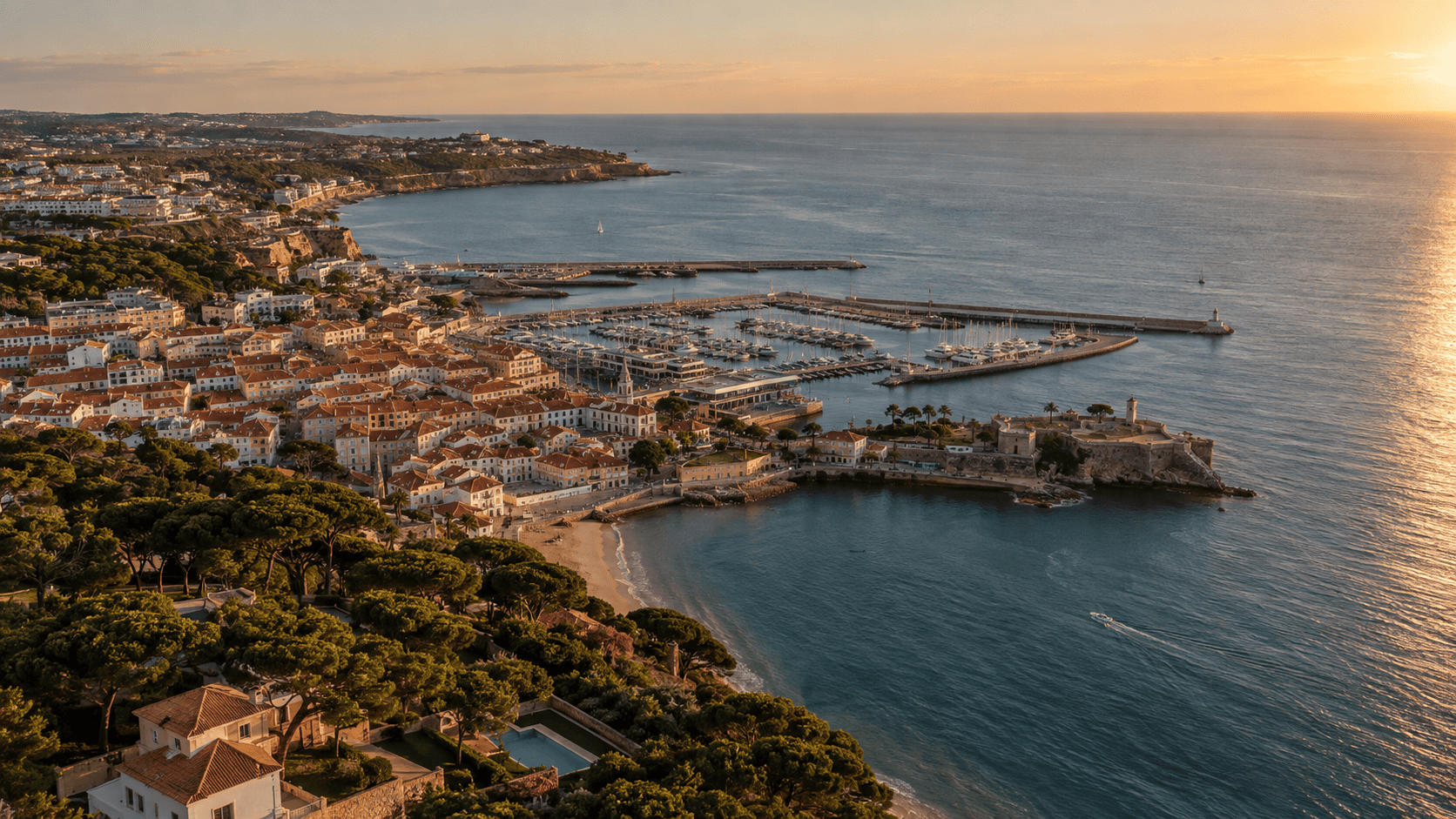
Portugal in the 2026 global wealth hubs index
Lisbon’s prime outprices Miami. Its average undercuts Berlin.
Savills published its 2026 Spotlight on Wealth Trends in October, built around a new index ranking more than 100 wealth hubs on their ability to attract the next generation of global capital. Two Portuguese markets appear in the EMEA top 30: Lisbon at 21st and Cascais at 23rd.
Cascais is the more interesting entry. A town of roughly 215,000 people, placed in a European ranking otherwise dominated by financial centers, Alpine resorts, and Mediterranean trophy markets — alongside Monaco, Geneva, St. Moritz, Portofino, and Capri.
The same report contains a figure that complicates the story Portugal usually tells about itself. On average prime price per square foot across 30 world cities, Lisbon ranks 13th — above Los Angeles, San Francisco, Miami, Madrid, Berlin, Amsterdam, Dubai, and Barcelona.
Set that against Deutsche Bank Research Institute data showing Lisbon 20th of 28 European cities on city-center apartment averages, below Berlin, Madrid, Rome, and Dublin.
Both are accurate. Lisbon’s general market is inexpensive by European standards and its prime market is not. The gap between them is wider than in almost any comparable city, and buyers who arrive on the first figure and shop in the second are regularly surprised.
What the index measures
Savills assessed more than 100 wealth hubs across four weighted pillars using 48 indicators, drawing on IMD, Oxford Economics, WealthX, PwC, Michelin, STR, flight data, QS, and Numbeo among other sources.
The pillars are business, governance and connectivity; wealth clusters and local environment, covering depth of local wealth, residential markets, and access to leading education; wealth management and taxation; and lifestyle.
The framing is the Great Wealth Transfer. Capgemini estimates $84 trillion will pass between generations over the next two decades, with $72 trillion going directly to heirs and $12 trillion to philanthropy. Altrata’s 2025 report counts 510,810 ultra-high-net-worth individuals globally holding roughly $60 trillion — more than the combined GDP of China and the United States.
Two mobility figures underpin the exercise. Approximately 80% of self-made UHNWIs live outside the country where they made their wealth, and nearly 20% of high-net-worth individuals live outside their country of birth.
Savills defines next-generation wealth as individuals under 40 who have inherited significant wealth, are positioned to benefit from the transfer, or built wealth through entrepreneurship.
Where Portugal actually sits
Precision matters here, because the headline will be misreported.
Lisbon ranks 21st in EMEA. Cascais ranks 23rd. Neither appears in the global top 30, which runs New York, Miami, London, San Francisco, Los Angeles, Singapore, Hong Kong, Dubai, Monaco, and Abu Dhabi at the head.
For regional context, London leads EMEA, followed by Dubai, Monaco, Abu Dhabi, Geneva, Paris, Milan, Amsterdam, Rome, and Stockholm. Madrid and Barcelona place 13th and 14th. Tuscany 17th. Lake Como 20th — immediately above Lisbon.
Italy and Switzerland dominate the EMEA list by volume. Italy fields Milan, Rome, Tuscany, Lake Como, Portofino, and Capri. Switzerland fields Geneva, Gstaad, St. Moritz, Crans-Montana, Zermatt, Verbier, and Villars. Portugal fields two.
Savills attributes Italy’s strength in the wealth clusters pillar substantially to its flat tax regime alongside its restaurant, retail, and cultural depth — a reminder that fiscal policy registers directly in these rankings.
The pricing paradox
This is the finding with the most practical consequence, and it emerges from reading the two datasets together.
In the Savills prime pricing table for June 2026, the order runs Hong Kong, Tokyo, Geneva, New York, Paris, Shanghai, London, Seoul, Sydney, Singapore, Milan, Rome, Lisbon, then Los Angeles, San Francisco, Beijing, Shenzhen, Miami, Guangzhou, Athens, Madrid, and onward through Berlin, Amsterdam, Dubai, and Barcelona.
Monaco sits outside that table as the world’s most expensive prime market at $6,135 per square foot, roughly €57,569 per square meter. Hong Kong leads the charted cities at $3,750 per square foot, around €34,800 per square meter.
Lisbon at 13th places Portuguese prime above eight markets that most buyers would assume more expensive.
Portuguese data from elsewhere supports it. Prime Lisbon addresses have been recorded at roughly €8,000 to €10,300 per square meter, with new construction on Avenida da Liberdade, Chiado, and Príncipe Real reaching €12,000. Quinta do Lago in the Algarve averaged around €11,145 per square meter in early 2026 — above prime Lisbon, and the highest average of any Portuguese address.
Against a Lisbon city-wide average near €5,900 and a national median transaction price around €2,111 per square meter, the prime premium in Portugal is unusually wide.
Three practical consequences.
A buyer researching Portugal on affordability data and then shopping prime is comparing two different markets. The affordability argument is real at the general level and largely disappears at the top.
An investor comparing Lisbon prime to Miami prime is not getting a discount. The comparison that favors Portugal is carrying cost and succession, not entry price.
And the wide premium itself tells you something about depth. A market where prime trades at four or five times the city average, in a country with a modest domestic high-end buyer base, is a market where prime pricing is set by international demand — which is a different risk profile from a market where domestic wealth supports it.
What Cascais in the index signals
Cascais appearing at 23rd in EMEA is the report’s most useful finding for anyone operating in Portugal.
The index weights lifestyle, wealth clusters, and local environment alongside business and taxation, which is why Alpine and coastal markets place at all. Savills notes that Alpine destinations have shifted from purely seasonal second-home markets toward year-round living, supported by international schools, healthcare, and extended summer provision — and makes a parallel observation about Southern Europe, where climate, schooling, healthcare, perceived safety, and international connectivity are supporting year-round rather than seasonal use.
Cascais fits that description precisely. It is a functioning year-round town rather than a resort, it holds the densest concentration of international schooling in Portugal, it is twenty-five minutes from Lisbon airport, and it is 81.3% foreign by acquisition.
What the ranking does not do is tell you Cascais is cheap, or that it is undiscovered. It tells you an independent global index assessed it against Monaco and Verbier and found it competitive on the measures that matter to internationally mobile families.
The transfer, and the one number that matters most
Of the $84 trillion moving between generations, $72 trillion passes directly to heirs. Savills notes that in many families the transfer has already begun, with wealth gifted during lifetimes to support succession planning and long-term stewardship.
That is the frame in which Portugal’s strongest structural feature should be read.
Portugal levies no inheritance tax. Gratuitous transfers attract stamp duty at 10% plus 0.8% on real estate, and transfers to a spouse, descendants, and ascendants are exempt. For a family passing Portuguese property down the direct line, the cost is effectively nil.
Compare the alternatives in the index. UK-situs assets sit within a 40% inheritance tax net permanently, regardless of the owner’s residence. France taxes direct-line succession on a scale reaching 45% at the margin. Italy charges 4% to 8% by relationship, though foreign-situs assets fall outside Italian inheritance tax while its flat tax regime applies. Spain’s position is regional, from near-relief to materially expensive.
Portugal also has no general wealth tax. AIMI applies only to Portuguese residential property and building land above €600,000 per person, or €1.2 million for a married couple, at 0.7% to 1.5%, assessed on tax-assessed value rather than market value. Portfolios, business holdings, and other assets fall outside it entirely.
And the EU Succession Regulation permits a foreign national to elect the law of their nationality to govern their whole estate, displacing Portuguese forced heirship. The election must be made expressly in a valid disposition; a standard notarial will does not achieve it.
Against a transfer of $72 trillion to heirs, a jurisdiction where direct-line transfer costs nothing and the governing law can be chosen is not a marginal consideration.
What Savills identifies as driving Portuguese demand
The report credits Portuguese markets with high quality-of-life scores, strong dining and retail provision, and relative affordability compared with other established European hubs.
It also names a specific demand source: buyers and renters from across Latin America supporting demand in both Spain and Portugal. That corroborates Banco de Portugal data placing Brazil among the leading foreign buyer nationalities in Portugal alongside Angola and France.
One further observation is worth noting because it cuts against the assumption that mobile wealth always buys. Across the Iberian Peninsula, Savills finds prime rental attractive to internationally mobile people precisely because it preserves the flexibility to split time across several locations — a pattern consistent with the report’s wider theme of multi-jurisdictional lifestyles balancing residence, education, and wealth structures across markets.
What the index does not say
Three limitations, stated because the report will be quoted selectively.
Neither Lisbon nor Cascais appears in the global top 30. They rank 21st and 23rd within EMEA, which is a regional placement.
No Portuguese location appears among the top 15 concentrations of high-net-worth individuals under 40. That list is led by New York, Los Angeles, San Francisco, Miami, and London, with Tuscany, Rome, Milan, Berlin, Geneva, and Paris representing Europe. Portugal is a destination for wealth rather than a significant creator of it, and the index measures both.
Portugal’s thin upper market remains a constraint. Savills’ outlook argues that scarce, turnkey, highly serviced assets in markets combining legal stability, lifestyle quality, privacy, and long-term liquidity will prove most resilient. Portugal delivers on the first three. On liquidity it delivers below roughly €10 million and thins materially above €20 million, where very few transactions completed in 2025 despite exceptional stock being available.
What next-generation wealth wants
The report identifies demand shifting toward branded residences, wellness-led developments, and turnkey property that allows owners to move between homes and jurisdictions without friction. Privacy, education, connectivity, and flexibility are described as increasingly determining location decisions alongside capital preservation.
Portugal’s position against that list is mixed and worth stating honestly.
It delivers on lifestyle, climate, safety, healthcare, international schooling concentrated in identifiable corridors, and direct connectivity to most of Europe and much of the Americas. It delivers exceptionally on succession and carrying cost.
It delivers partially on turnkey and branded product. Portugal’s branded residence pipeline is growing but remains small relative to Dubai, Miami, or Milan, and a substantial share of attractive Portuguese stock requires renovation rather than being move-in ready.
It does not deliver on the business-creation pillar, on depth of local wealth, or on liquidity at the top of the market. Those are structural and will not change quickly.
A family assembling the kind of multi-jurisdictional position the report describes should expect Portugal to be a leg of it — the real-asset, succession, and lifestyle leg — rather than the center.
What a buyer should take from this
The affordability argument is general, not prime. If the appeal of Portugal is price, that argument holds in the broad market and in secondary cities, and largely dissolves at the top. Lisbon prime is not a discount to Miami prime.
The succession argument is the strongest one and it is undervalued. Against $72 trillion passing to heirs, nil direct-line transfer plus the ability to elect your own national succession law is a genuine structural advantage that most buyers never properly claim.
Cascais is competitive on measures that independent research recognizes, which is worth knowing for both acquisition and eventual resale.
And the liquidity constraint is real. Buy within the band where the market functions.
How Luznur Capital works
Luznur Capital, a trading name of Lusomena Investments, Unipessoal Lda., is a real estate brokerage and advisory firm licensed by IMPIC under AMI 22354 and a registered member of APEMIP.
Reading indices against actual pricing. A ranking describes a market; it does not price a property. Establishing what genuinely comparable stock has achieved, including privately, is what determines whether a specific price is right — particularly in a market where the prime premium over the general average is as wide as Portugal’s.
Succession built in at acquisition. The EU Succession Regulation election and the direct-line position are claimed through documentation prepared at purchase, coordinated with Portuguese and home-jurisdiction counsel, not addressed later.
Off-market access. In Cascais, prime Lisbon, Comporta, and the Algarve, a meaningful share of the better property never reaches a portal. Sourcing against a defined brief produces a different shortlist than a public search.
Honest positioning on liquidity. Who buys the asset from you, at what size, and over what period is analysis rather than formality above €10 million.
FAQ
How does Portugal rank in the Savills Next-Generation Wealth Hubs Index?
Lisbon ranks 21st and Cascais 23rd in the EMEA top 30. Neither appears in the global top 30, which is led by New York, Miami, London, San Francisco, and Los Angeles. The index assessed more than 100 wealth hubs across four pillars using 48 indicators.
Why is Cascais in a global wealth index?
Because the index weights lifestyle, wealth clusters, and local environment alongside business and taxation, which is why coastal and Alpine markets place at all. Cascais functions as a year-round town rather than a seasonal resort, holds Portugal’s densest concentration of international schooling, sits twenty-five minutes from Lisbon airport, and is 81.3% foreign by acquisition.
Is prime property in Lisbon expensive?
More than most buyers assume. On Savills’ average prime price per square foot across 30 world cities, Lisbon ranks 13th — above Los Angeles, San Francisco, Miami, Madrid, Berlin, Amsterdam, Dubai, and Barcelona. On city-wide apartment averages Lisbon ranks 20th of 28 European cities, below Berlin, Madrid, Rome, and Dublin. The prime premium over the general market is unusually wide.
What is the Great Wealth Transfer?
An estimated $84 trillion passing between generations over the next two decades according to Capgemini, with $72 trillion going directly to heirs and $12 trillion to philanthropy. Savills notes that in many families the transfer has already begun through lifetime gifting for succession planning purposes.
Why does Portugal matter for succession planning?
It levies no inheritance tax, and the stamp duty applying to gratuitous transfers does not apply to a spouse, descendants, or ascendants. For a family passing property down the direct line the cost is effectively nil, against 40% permanently on UK-situs assets and up to 45% at the margin in France. The EU Succession Regulation also permits electing your own national law to govern the estate.
Who is buying in Portugal according to this research?
Savills identifies buyers and renters from across Latin America as supporting demand in both Spain and Portugal, which corroborates Banco de Portugal data placing Brazil among the leading foreign nationalities in Portuguese transactions alongside Angola and France.
Does Portugal have a wealth tax?
No general wealth tax. AIMI applies only to Portuguese residential property and building land above €600,000 per person, or €1.2 million for a married couple, at 0.7% to 1.5%, assessed on tax-assessed value rather than market value. Portfolios, business holdings, and other assets fall outside it entirely.
What are the limitations of Portugal’s position?
Neither Portuguese market reaches the global top 30. No Portuguese location appears among the top 15 concentrations of high-net-worth individuals under 40, indicating Portugal is a destination for wealth rather than a significant creator of it. And liquidity thins materially above €20 million, where very few transactions completed in 2025.
What does next-generation wealth want from property?
Savills identifies demand shifting toward branded residences, wellness-led developments, and turnkey property allowing movement between homes and jurisdictions. Privacy, education, connectivity, and flexibility are described as increasingly determining location decisions alongside capital preservation.
Which European markets lead the index?
London leads EMEA, followed by Dubai, Monaco, Abu Dhabi, Geneva, Paris, Milan, Amsterdam, Rome, and Stockholm. Italy fields six EMEA entries and Switzerland seven, with Savills attributing Italy’s wealth cluster strength substantially to its flat tax regime.
Is this article investment advice?
No. It reports publicly available research as of October 2026 and is not a recommendation regarding any property, market, or transaction. Index rankings are not valuations and do not indicate investment merit.
DISCLAIMER
Important information
This article is provided for general information only and reflects publicly available information as of October 2026. It does not constitute investment, financial, tax, or legal advice, and is not a recommendation regarding any property, market, or transaction.
Findings attributed to the Savills Spotlight on Wealth Trends 2026 and the Savills Next-Generation Wealth Hubs Index are reported as published by Savills Research, which retains copyright in that publication. The index reflects that firm’s methodology, indicator selection, and weighting across more than 100 locations, and index rankings are not valuations, forecasts, or indicators of investment merit. Wealth transfer estimates are attributed by Savills to Capgemini and wealth population figures to Altrata.
Price figures derive from multiple sources including Savills Research and the Deutsche Bank Research Institute, which measure different populations using different methodologies, currencies, and units, and are not directly comparable. Prime pricing and city-wide averages describe different market segments. All figures are indicative of relative position rather than valuations of any property.
Tax treatment in every jurisdiction referenced depends on individual circumstances and is subject to change. United Kingdom, French, Italian, and Spanish provisions are summarized at a general level and must be confirmed with qualified advisors locally. Portuguese provisions referenced are subject to amendment, and Portugal has revised rules affecting foreign investors repeatedly since 2023.
Luznur Capital is a trading name of Lusomena Investments, Unipessoal Lda., a real estate brokerage and advisory firm licensed by IMPIC under AMI 22354 and a registered member of APEMIP. It is not a law firm or tax practice. Independent legal and tax advice should be obtained before any acquisition or succession planning decision.
SHORT TOP-OF-PAGE DISCLAIMER VARIANT
Reports third-party research published October 2026 by Savills Research, which retains copyright. Index rankings are not valuations or indicators of investment merit, and price figures from different sources measure different segments and are not directly comparable. Not investment, tax, or legal advice. Luznur Capital (Lusomena Investments, Unipessoal Lda., AMI 22354).
Positioning Portugal within a wider structure
An index ranks markets. It does not price a property, claim a succession position, or tell you who will buy the asset from you.
Luznur Capital, a trading name of Lusomena Investments, Unipessoal Lda. (AMI 22354), advises international buyers and investors across Lisbon, Cascais, Sintra, the Setúbal peninsula, Comporta and the Alentejo, the Algarve including Quinta do Lago and Tavira, the Silver Coast, Porto and Braga, the Douro and the Minho, and Madeira, including off-market opportunities, with coordinated legal, tax, and immigration partners — and on mandates of any size in any region of mainland Portugal and the islands.
To discuss a specific mandate, contact info@luznurcapital.com.
Tag:
Category:
- Alentejo (1)
- Algarve (15)
- Almancil (5)
- Buyer Guides by Nationality (6)
- Buying in Portugal (22)
- Cascais (6)
- Comporta (6)
- Costs & Fees (2)
- Country Comparisons (3)
- D7 Visa (5)
- D8 Visa (4)
- Diplomacy (1)
- Eastern Algarve (3)
- Economy (9)
- Estoril (5)
- Foreign Bilateral Relations (3)
- GCC (2)
- GCC Investors Portugal (2)
- Golden Triangle Algarve (5)
- Golden Visa (2)
- Golden Visa Portugal (2)
- High-Profile Clients (1)
- HNWIs (16)
- International Buyers (24)
- Investing in Portugal (29)
- Investment (6)
- Investment & Advisory (17)
- Investment & Structuring (1)
- Lisbon (11)
- Lisbon (5)
- Market Data (8)
- Market Guides (8)
- Porto (6)
- Portugal (16)
- Quinta da Marinha (6)
- Quinta do Lago (11)
- Real Estate Portugal (32)
- Relocating to Portugal (14)
- Relocation (1)
- Residency & Investment (2)
- Sotavento Algarve (3)
- Tavira (7)
- Tourism (4)
- Vale do Lobo (5)
- Vila Real de Santo António (1)
- Vilamoura (5)
- Wealth Management (1)
- Wealth Management Portugal (4)