 (+351) 932 224 792
  info@luznurcapital.com
Portugal for Qatari investors
Portugal for Qatari investors: what the case actually rests on
Most articles about buying Portuguese property are written for someone with a problem. Capital that cannot easily leave the country. An income tax bill at home that Portugal might reduce.
A Qatari buyer has neither.
The Qatari riyal is pegged to the dollar and fully convertible. There are no exchange controls to work around and no exit charge on leaving. Qatar levies no personal income tax, no wealth tax, no capital gains tax on individuals, and no inheritance tax — so Portugal is not a tax saving, it is a tax cost.
Two of the three arguments usually made for Portugal therefore do not apply, and an adviser who offers them has not thought about the client.
What remains is narrower and, for a certain kind of family, more durable. This article sets out what it actually is.
Where Qatari capital has already gone
The pattern is well established and almost entirely Anglo-French.
The United Kingdom was the first destination for Qatari foreign direct investment, at more than $40 billion, with France and Germany following at roughly $27 billion and $24 billion. MSCI Real Assets reports that Qatar is now the tenth-largest landowner in Great Britain.
That concentration extends to private families, not just the sovereign fund. Research by a Doha-based real estate firm found the number of homes owned by Qatari individuals in the United Kingdom doubled between 2018 and 2021.
The Qatar Investment Authority, with assets variously estimated between $510 billion and $600 billion in 2026 and projected to exceed $800 billion by 2030 on LNG expansion revenues, maintains real estate teams in London and Paris and has concentrated its property exposure in those two cities.
That institutional pattern is not Luznur Capital’s business and will not be. But it is the context in which Qatari private families form their expectations. London and Paris are where Qatari capital has learned to buy European property, and both have changed.
What changed in London
This is the dateable part of the argument, and it bears directly on a Qatari family holding UK property.
The United Kingdom abolished the non-domiciled regime on 6 April 2025, ending more than two centuries of the remittance basis. Inheritance tax moved to a residence basis, reaching worldwide assets once an individual has been UK resident for ten of the last twenty tax years, with a tail of up to ten years after departure.
Separately and independently of any residence question, UK-situs assets remain within the scope of UK inheritance tax permanently, at 40%.
A Qatari family holding £50 million of London property carries roughly £20 million of exposure, regardless of where the family lives, on assets that confer no residence rights.
On acquisition, a non-resident buying an additional UK dwelling faces stamp duty stacking a 5% additional dwelling surcharge and a 2% non-resident surcharge onto standard rates, reaching 19% above £1.5 million. Corporate and trust purchases are charged at a flat 17%, or 19% for non-resident entities, with the Annual Tax on Enveloped Dwellings applying to residential property held through companies above £500,000.
France applies the IFI, a wealth tax reaching real estate and nothing else, at 0.5% to 1.5% above a €1.3 million threshold — roughly €35,700 annually on €5 million of French property.
A Qatari family with heavy UK and French property exposure is, in other words, paying annual and succession charges on a concentration built when those charges were lower.
What Portugal actually offers
Six things, and none of them is a tax break on income.
No general wealth tax. AIMI applies only to Portuguese residential property and building land above €600,000 per person, or €1.2 million for a married couple, at 0.7% to 1.5% — and it is assessed on VPT, the tax-assessed value, which for prime property is typically a fraction of the purchase price. Financial assets, portfolios, and business holdings fall entirely outside it.
For a family accustomed to no wealth tax at home, this matters as the absence of a cost that France and Spain would impose rather than as a benefit.
No inheritance tax. Transfers to a spouse, descendants, and ascendants are exempt from the stamp duty that otherwise applies to gratuitous transfers. Against the 40% permanent charge on UK-situs assets, that is the single largest structural difference between a Portuguese and a British holding.
Euro denomination. The riyal is pegged to the dollar, which means a Qatari family’s wealth is effectively dollar-denominated whatever currency it sits in. Euro-denominated real assets in an EU member state are a genuine currency diversification rather than a nominal one — a point that applies with more force to Qatari capital than to almost any other Gulf nationality.
An EU legal framework. Property rights under EU law, an independent judiciary, title registered and searchable, and a transaction process that does not depend on relationships. For families diversifying across jurisdictions, legal predictability is part of what is being bought.
Price. Lisbon city-center apartments average roughly €6,636 per square meter on Deutsche Bank Research Institute data, 20th of 28 European cities and 27% below the European average. Prime Lisbon runs €8,000 to €10,300, with the best new build reaching €12,000. Against London and Paris — where Qatari capital has concentrated — that is a substantially lower entry point for comparable quality.
Privacy. Portuguese transactions attract markedly less press attention than equivalents in London or Paris, and Portugal has no public beneficial ownership register equivalent to those in several other European jurisdictions. For families whose visibility is itself a consideration, that is substantive.
Mobility, and what may be about to change
Qatari nationals currently require a Schengen visa for travel to Portugal and the rest of the Schengen Area. Among the GCC states, only the United Arab Emirates holds a visa waiver.
That may not remain the position for long. Speaking in October 2026, the Secretary-General of the Gulf Cooperation Council said that waiving the Schengen requirement for the five remaining GCC states — Saudi Arabia, Qatar, Oman, Bahrain, and Kuwait — is “very close,” and indicated that an announcement on beginning the process is expected at the EU-GCC summit in Riyadh on 24 October 2026.
Two cautions are worth stating. What was described is the beginning of a process rather than its conclusion, and visa liberalization between the EU and third countries typically requires legislative steps and ratification that take time. And separately, ETIAS pre-travel authorization will apply to visa-exempt nationals once operational.
So the honest position today is that a Qatari buyer requires a visa for each trip, with a credible prospect of that changing and no confirmed date.
A Portuguese residence permit removes the question entirely, granting the right of entry and movement within the Schengen Area regardless of where the visa negotiations land. Residence permit holders also sit outside the EU Entry/Exit System, which has recorded Schengen entries and exits biometrically since April 2026.
Where residency has value beyond that: for stays exceeding the ninety-day Schengen allowance, for access to Portuguese healthcare, schooling, and banking on resident terms, and for families wanting a long-term European option held in reserve rather than exercised.
If that applies, the route is the Golden Visa — property has not qualified since October 2023, leaving CMVM-regulated funds at €500,000, cultural heritage donation, capital transfer, business creation, and research investment, with a presence requirement averaging seven days per year. Citizenship now requires ten years under Organic Law No. 1/2026, with the clock running from issuance of the residence title.
Whether that is worth doing depends partly on how the Riyadh discussions develop, and it is a separate decision from the property.
Succession, and the election worth making
Portugal applies forced heirship in domestic law — a reserved portion that must pass to protected heirs regardless of what a will provides.
The EU Succession Regulation permits an individual to elect the law of their nationality to govern their entire estate, and that choice is not limited to EU law. For a Qatari national, the election points to Qatari succession law, which for Muslims applies Sharia-based rules.
For many families this is precisely the intended outcome, and very little published material explains that the option exists.
Two qualifications apply. The election must be made expressly in a valid disposition of property upon death — a standard Portuguese notarial will does not achieve it. And the Regulation permits a court to refuse to apply a provision of the chosen law where its application would be manifestly incompatible with the public policy of the forum. Whether and how a Portuguese court would apply that test to Sharia-based distribution rules is unsettled, and European practice is not uniform.
This requires coordinated Portuguese and Qatari legal advice rather than a template.
Tax, stated without spin
For a non-resident owner, which most Qatari buyers will be: a flat 7.5% IMT on residential property from 1 September 2026 with no exemptions, plus 0.8% stamp duty, bringing total acquisition costs to roughly 9% to 10%. Rental income at a flat 25% on net residential lettings. AIMI only above the thresholds above, on tax-assessed value. No inheritance tax on direct-line transfer.
For a resident, Portugal taxes worldwide income at progressive rates reaching 48% with a solidarity surcharge above €80,000. The IFICI regime that replaced NHR requires a qualifying degree at EQF level 6 or above and a designated high-skilled activity performed in Portugal, and excludes pension income entirely.
Against Qatar’s position — no personal income tax, no wealth tax, no capital gains tax, no inheritance tax — Portuguese residency is a straightforward increase. Any adviser presenting it as a saving is either confused or not being straight with you.
The non-resident position is the relevant one for almost every Qatari buyer, and on that basis Portugal compares well against the European alternatives rather than against Qatar.
Financing
Conventional mortgages are available to non-residents at typically 60% to 70% of value, with Banco de Portugal having tightened the framework in August 2026 by cutting the maximum debt-service ratio to 45% of net income.
Portugal has no domestic Sharia-compliant mortgage market. No Portuguese bank offers murabaha, ijara, or diminishing musharaka products for residential property. For a buyer who will not take interest-bearing debt, the realistic routes are cash purchase or Sharia-compliant financing arranged in the Gulf and secured against the Portuguese asset.
Given that Qatari buyers at this level are frequently cash purchasers in any case, this constrains less than it would elsewhere — but it should be established before a timetable is agreed.
Where
Cascais and Estoril for a family base. A town that functions year-round rather than seasonally, most of Portugal’s international schooling in one corridor, twenty-five minutes to Lisbon airport, and 81.3% foreign ownership. Savills placed Cascais 23rd in EMEA in its 2026 next-generation wealth hubs index.
Lisbon for a city position, with the country’s principal Muslim infrastructure including the Lisbon Central Mosque and an established halal supply, alongside the best connectivity.
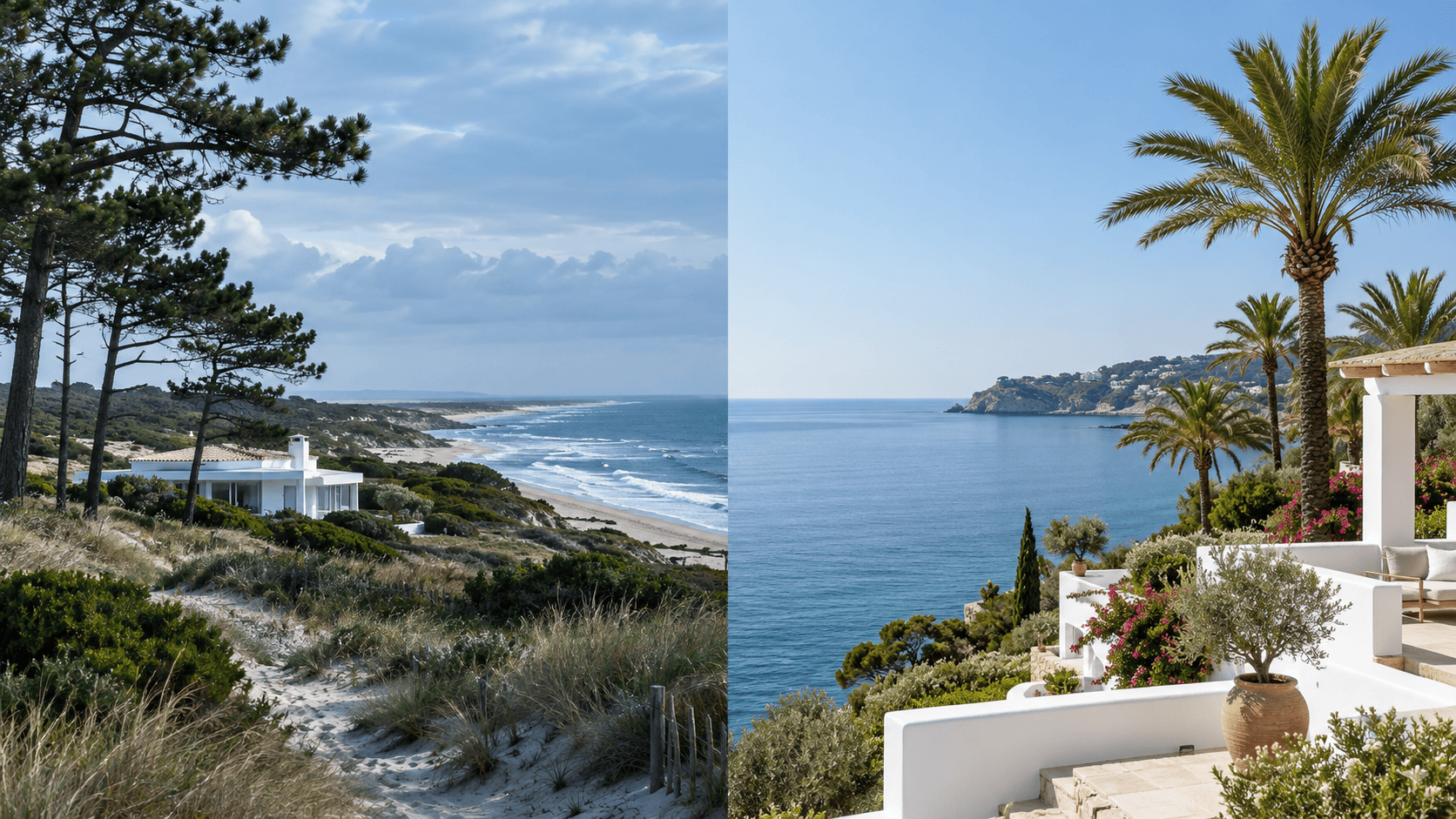
Comporta and the Alentejo coast where privacy is structural rather than promised — sixty kilometers of near-empty Atlantic beach an hour from Lisbon, with density capped by nature reserve designation.
The Algarve for golf-led resort use, with the Golden Triangle at roughly 80% international ownership and direct European connectivity through Faro.
On scale, honestly
Portugal’s prime residential market is liquid below roughly €10 million and materially thinner above. Very few residential transactions completed above €20 million in 2025 despite exceptional stock being available, so a family accustomed to London or Paris pricing should calibrate both what a house costs here and what it will resell for.
That said, properties at genuine scale do exist and do transact. Villas in Quinta da Marinha have been advertised at up to €19.9 million, with Rua Birre in Cascais carrying an average house price near €3.93 million. Quinta do Lago averages around €11,145 per square meter, the highest of any Portuguese address. Comporta prime runs between roughly €6,800 and €10,700 per square meter, with estate-scale holdings on the Alentejo coast reaching considerably higher.
Commercial, hospitality, and development equity are a different question entirely. Portugal’s commercial market absorbed roughly €1.4 billion in the first half of 2026 at an average ticket under €31 million, with individual assets trading well above that — a resort sale at a reported €120 to €140 million, alongside shopping centers, hotel portfolios, and logistics platforms. Foreign investors accounted for approximately 71% of hotel investment in the first half of 2025.
Development equity is where the capital shortage actually sits. Portugal licensed 42,048 dwellings in 2025 against 26,714 completions, bank leverage tightened when the ECB raised rates in June, and the country has no deep domestic institutional equity base. Approved projects exceed the capital available to build them, and positions are taken through joint venture equity, preferred equity, forward funding, or platform-level investment alongside local sponsors.
So the answer depends on the mandate. A single prime residence is capped by residential liquidity. A hotel, a retail asset, a logistics platform, a development position, or an estate on the Alentejo coast is not.
And a defined mandate reaches further than a search does. Portugal has no multiple listing service and no shared inventory. Sellers at the top of the market frequently avoid listing at all — for discretion, or because a publicly marketed property that fails to sell carries a stigma. What is advertised is therefore a partial and often residual view of what is actually available.
Where a buyer brings a specific brief — price, location, scale, and timing — the market can be approached directly by Luznur Capital: owners, developers, and lawyers acting for the buyer. That is a different exercise from reviewing what is advertised, and it is the one that produces results above the price points where portals thin out.
What Portugal cannot offer at any ticket size is the exit depth of London or Paris. Positions here are held to a plan rather than traded, and that should be understood at entry whatever the asset class.
Connectivity
Routings between Doha and Lisbon run through the Doha hub with onward European connections; current schedules should be confirmed directly rather than assumed. Lisbon serves 144 international destinations with particular depth on transatlantic and African routes.
For a family already traveling frequently to London or Paris, Lisbon is a short additional leg rather than a separate journey.
Sequencing
Establish whether residency is required, or whether the objective is the asset alone. That answer may depend partly on how the Schengen discussions develop, and it should be revisited rather than assumed settled.
Confirm the structure with Qatari and Portuguese counsel before acquisition, since the holding vehicle affects succession, privacy, and the transfer tax position.
Put the succession election in place at acquisition, drafted expressly, with advice on both sides.
Establish the financing position early where Sharia-compliant structures are required.
Then buy, within the band where the market functions — or against a defined mandate where it does not.
How Luznur Capital works with Qatari clients
Luznur Capital, a trading name of Lusomena Investments, Unipessoal Lda., is a real estate brokerage and advisory firm licensed by IMPIC under AMI 22354 and a registered member of APEMIP.
Honest framing of what Portugal does and does not offer. For a Qatari family the case is narrower than the marketing suggests, and saying so is the starting point rather than a caveat.
Off-market access. In Cascais, prime Lisbon, Comporta, and the Algarve, a meaningful share of the better property never reaches a portal. Sourcing against a defined brief produces a different shortlist than a public search, and does so without a name entering circulation.
Beyond residential. Where the requirement is income-producing or development capital rather than a house — a hotel, retail or logistics asset, a mixed-use portfolio, or joint venture equity in a residential scheme — the sourcing, underwriting, and counterparty work differs substantially from a private purchase, and the market absorbs considerably larger tickets.
Succession built in at acquisition. The EU Succession Regulation election and the direct-line position are claimed through documentation prepared at purchase, coordinated with Portuguese and home-jurisdiction counsel.
Discretion as standard practice. Non-disclosure at first contact extended to any partner brought into the mandate, no marketing use of transactions, and need-to-know disclosure to the professionals engaged.
FURTHER READING
Portugal from the Gulf — the regional view, covering the GCC corridor and how Gulf capital approaches the Portuguese market.
Portugal for British buyers and retirees — the UK changes in full, including why UK-situs assets stay in the 40% inheritance tax net permanently.
Is €5 million enough for Portuguese real estate? — what a defined allocation buys in a market where the average commercial ticket is under €31 million.
Golden Visa Comparison 2026: Portugal vs Europe & UAE — relevant where a long-term European option forms part of the plan.
FAQ
Do Qatari citizens need a visa for Portugal?
Yes, currently. Qatari nationals require a Schengen visa, and among the GCC states only the United Arab Emirates holds a visa waiver. In October 2026 the GCC Secretary-General said a waiver for the five remaining states is “very close,” with an announcement on beginning the process expected at the EU-GCC summit in Riyadh on 24 October 2026. That describes the start of a process rather than its conclusion, and no date has been confirmed.
Can Qataris buy property in Portugal?
Yes. Portugal places no restriction on foreign ownership — no nationality test, no quota, no permission requirement. Qatari buyers purchase on identical terms to EU nationals, needing a Portuguese tax number and, as non-EU nationals, generally a fiscal representative.
Is Portugal a tax saving for a Qatari buyer?
No. Qatar levies no personal income tax, no wealth tax, no capital gains tax on individuals, and no inheritance tax, so Portuguese tax residency is an increase rather than a reduction. The relevant comparison for most Qatari buyers is against other European jurisdictions, where Portugal compares well on wealth taxation and succession.
What does buying cost in Portugal?
From 1 September 2026, buyers who are not Portuguese tax residents pay a flat 7.5% IMT with no exemptions, plus 0.8% stamp duty, with notary, registration, and legal fees bringing total acquisition costs to roughly 9% to 10% of price. None of it can be financed.
Why are Qatari families looking beyond London?
Qatari capital is heavily concentrated in the United Kingdom, which is the tenth-largest landowner position in Great Britain, with Qatari individual homeownership there doubling between 2018 and 2021. The UK abolished the non-domiciled regime in April 2025, moved inheritance tax to a residence basis, and keeps UK-situs assets permanently in the 40% inheritance tax net regardless of owner residence. Stamp duty for non-resident buyers of additional dwellings reaches 19%.
Does Portugal have a wealth tax or inheritance tax?
No general wealth tax. AIMI applies only to Portuguese residential property and building land above €600,000 per person, or €1.2 million per married couple, at 0.7% to 1.5%, assessed on tax-assessed value rather than market value. There is no inheritance tax, and transfers to a spouse, descendants, and ascendants are exempt.
Can Sharia inheritance rules apply to my Portuguese property?
The EU Succession Regulation permits electing the law of your nationality to govern your estate, and that choice is not limited to EU law — for a Qatari national it points to Qatari succession law. The election must be made expressly in a valid disposition, and a public policy exception exists whose application to Sharia-based rules is unsettled. Coordinated Portuguese and Qatari legal advice is required.
Are there Sharia-compliant mortgages in Portugal?
No. No Portuguese bank offers Islamic financing products for residential property. The realistic routes are cash purchase or Sharia-compliant financing arranged in the Gulf and secured against the Portuguese asset. Conventional non-resident mortgages are available at typically 60% to 70% of value.
Does a Qatari buyer need the Golden Visa?
It depends on intended use and may depend on how the Schengen discussions develop. A residence permit grants entry and movement within the Schengen Area regardless, places the holder outside the EU Entry/Exit System, and covers stays beyond the ninety-day allowance along with access to healthcare, schooling, and banking on resident terms. Property has not qualified since October 2023, and citizenship now requires ten years.
How large a position can Portugal absorb?
Prime residential is liquid below roughly €10 million and thinner above, with very few residential transactions completing above €20 million in 2025. Commercial, hospitality, and development are different — the commercial market absorbed roughly €1.4 billion in the first half of 2026, with individual assets including a resort sale at a reported €120 to €140 million. The ceiling depends on the asset class, not on the country.
Is this article tax or legal advice?
No. It presents general information as of October 2026 on Portuguese tax, residency, and succession rules, all of which are complex and subject to change. Independent professional advice is required in both jurisdictions before any decision.
DISCLAIMER
Important information
This article is provided for general information only and reflects publicly available information as of October 2026. It does not constitute legal, tax, immigration, investment, or Sharia advice in any jurisdiction.
Statements regarding prospective changes to Schengen visa arrangements for GCC nationals reflect remarks reported in October 2026 and describe an anticipated political announcement rather than a legal change. Visa liberalization requires legislative and ratification steps, no date has been confirmed, and nothing here should be relied upon in planning travel. ETIAS pre-travel authorization will apply to visa-exempt nationals once operational. Current entry requirements must be confirmed with the relevant consular authorities before travel.
Portuguese provisions referenced — including Decree-Law No. 97/2026, Organic Law No. 1/2026, the IFICI regime, and the ARI framework — are subject to amendment, and Portugal has revised rules affecting foreign investors repeatedly since 2023. United Kingdom and French provisions are summarized at a general level and must be confirmed with qualified advisers in those jurisdictions.
The interaction between the EU Succession Regulation and Sharia-based succession rules involves unsettled questions, including the public policy exception, on which European practice is not uniform.
Figures relating to Qatari investment abroad derive from published reporting and third-party research and are indicative rather than authoritative. Property price and transaction data derive from published indices and market reporting using differing methodologies and are indicative of relative position rather than valuations. References to properties and transactions at particular price levels describe market activity and do not indicate availability or any mandate held by Luznur Capital.
Real estate investment and development involve substantial risk including illiquidity, entitlement failure, cost overrun, counterparty default, and loss of capital. Investment funds carry risk including total loss of capital, and nothing here is a recommendation of any fund or manager.
Luznur Capital is a trading name of Lusomena Investments, Unipessoal Lda., a real estate brokerage and advisory firm licensed by IMPIC under AMI 22354 and a registered member of APEMIP. It is not a law firm, tax practice, immigration advisor, or provider of Sharia compliance opinions, and does not advise on Qatari law. Independent professional advice must be obtained in both jurisdictions before any acquisition, residency, or estate planning decision.
General information as of October 2026, not legal, tax, immigration, or Sharia advice. Remarks on prospective Schengen visa changes describe an anticipated announcement, not a legal change — confirm current entry requirements with consular authorities. Luznur Capital (Lusomena Investments, Unipessoal Lda., AMI 22354).
Considering Portugal from Doha
The usual arguments for Portugal do not apply to a Qatari buyer. What remains is a euro-denominated real asset in an EU jurisdiction, at a fraction of London or Paris pricing, passing to the next generation at no tax and under a law you can choose.
Luznur Capital, a trading name of Lusomena Investments, Unipessoal Lda. (AMI 22354), advises international buyers and investors across Lisbon, Cascais, Sintra, the Setúbal peninsula, Comporta and the Alentejo, the Algarve including Quinta do Lago and Tavira, the Silver Coast, Porto and Braga, the Douro and the Minho, and Madeira, including off-market opportunities, with coordinated legal, tax, and immigration partners — and on mandates of any size in any region of mainland Portugal and the islands.
Enquiries are handled in confidence. Contact info@luznurcapital.com.
Tag:
Category:
- Alentejo (1)
- Algarve (15)
- Almancil (5)
- Buyer Guides by Nationality (6)
- Buying in Portugal (21)
- Cascais (6)
- Comporta (6)
- Costs & Fees (2)
- Country Comparisons (3)
- D7 Visa (5)
- D8 Visa (4)
- Diplomacy (1)
- Eastern Algarve (3)
- Economy (9)
- Estoril (5)
- Foreign Bilateral Relations (3)
- GCC (2)
- GCC Investors Portugal (2)
- Golden Triangle Algarve (5)
- Golden Visa (1)
- Golden Visa Portugal (2)
- HNWIs (16)
- International Buyers (24)
- Investing in Portugal (29)
- Investment (6)
- Investment & Advisory (14)
- Investment & Structuring (1)
- Lisbon (11)
- Lisbon (5)
- Market Data (6)
- Market Guides (8)
- Porto (6)
- Portugal (16)
- Quinta da Marinha (6)
- Quinta do Lago (11)
- Real Estate Portugal (32)
- Relocating to Portugal (14)
- Relocation (1)
- Residency & Investment (2)
- Sotavento Algarve (3)
- Tavira (7)
- Tourism (4)
- Vale do Lobo (5)
- Vila Real de Santo António (1)
- Vilamoura (5)
- Wealth Management (1)
- Wealth Management Portugal (4)