(+351) 932 224 792
 info@luznurcapital.com
Buying an Alentejo Estate or Manor House
An Alentejo estate or manor house offers space, history, and privacy rarely available elsewhere in Western Europe, at a fraction of coastal prices. But the land usually carries strict rules — rural classification, protected cork and holm oaks, ecological and agricultural reserves, and sometimes heritage protection — and most properties need restoration. What can be restored, extended, or built must be confirmed before purchase, not discovered after.
This applies to buyers of herdades, montes, manor houses, and country estates across the Alentejo, from Évora and Arraiolos to Estremoz, Vila Viçosa, and the plains toward Beja.
The main qualification: on an Alentejo estate, the planning position and the restoration plan decide the real price — and both should be settled before you commit.
What you’re actually buying
| Type | What it is | Typical character |
|---|---|---|
| Herdade | A large rural estate, often agricultural | Cork and holm oak montado, olives, vines, or grazing; often hundreds of hectares |
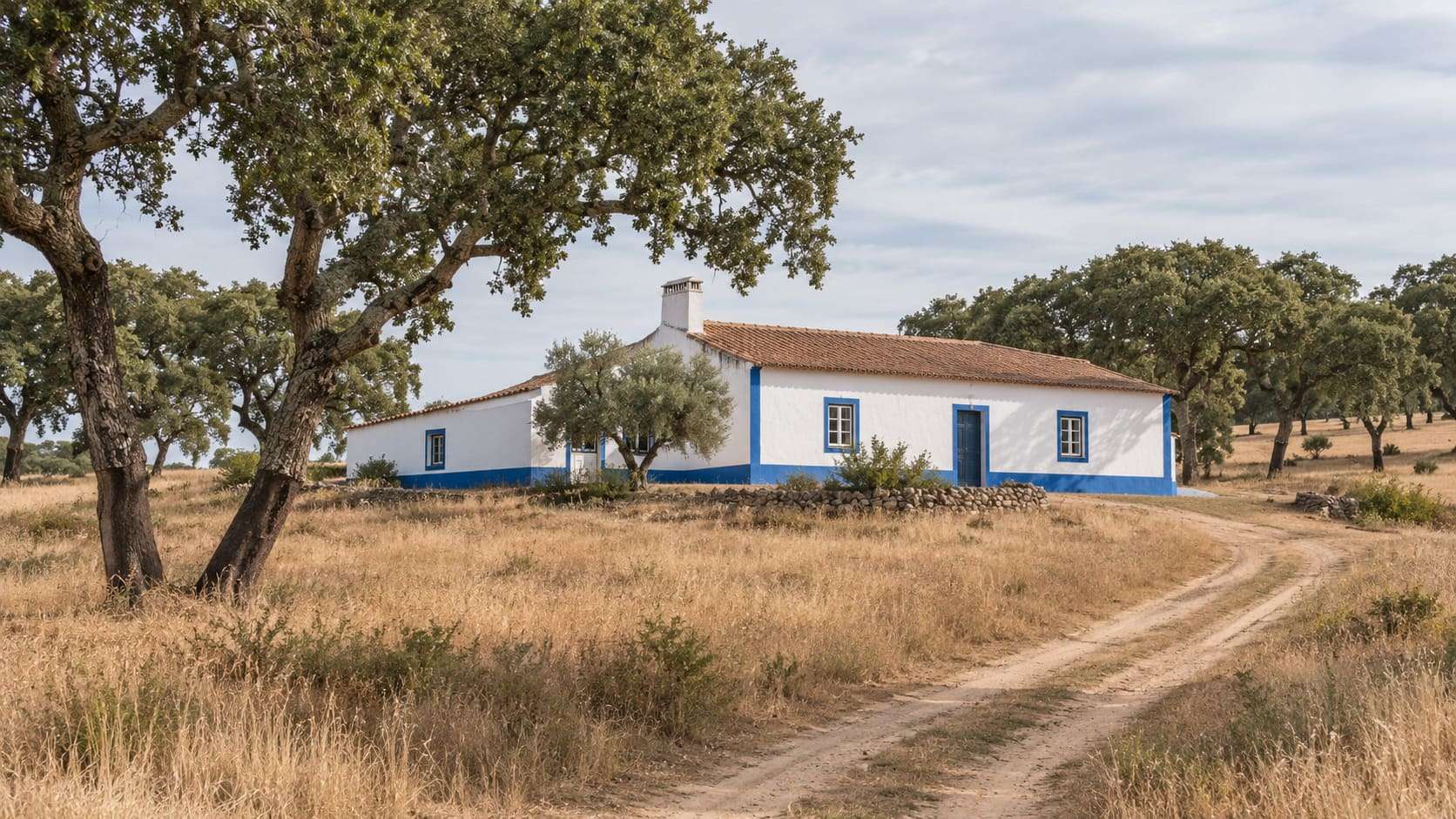
| Monte | The traditional whitewashed farmhouse of the Alentejo | Single-story, thick walls, on a rise above its land |
| Manor house | A historic residence, in a town or on an estate | Larger rooms, chapels, courtyards; sometimes listed |
| Quinta or country house | A smaller estate with a main house | A few hectares, gardens, outbuildings |
Many estates are registered as mixed properties — part urban, part rural — and the line between the two on the registry decides what can be built and how each part is taxed.
Why the Alentejo
Space. Estates of a size and seclusion that are rare within two hours of a European capital.
Tranquility. One of the least densely populated regions of Western Europe, where the nearest neighbor may be out of sight and out of hearing, and evenings end in a silence most cities have forgotten.
Price. Well below the coast, even after strong recent growth — regional prices rose sharply in the year to April 2026.
Évora. A World Heritage city, and European Capital of Culture in 2027, about an hour and a half from Lisbon.
Landscape and life. Wine, cork, olive oil, long dry summers, and towns that have kept their character.
The land rules that matter
Rural land rarely carries new building rights. What exists — and what was lawfully built — is usually what you can restore. Extensions are limited by the municipal master plan.
A ruin is not a building right. Rebuilding depends on proving the original building existed lawfully. Without that, a ruin may be worth only the land beneath it.
Cork oaks and holm oaks are protected by law. Felling or damaging them requires authorization, which limits where you can build, plant, or clear.
Agricultural and ecological reserves may cover parts of the estate and restrict use further.
Heritage protection. Listed buildings, and land near classified monuments, need heritage approval for works — which adds time and shapes the design.
Fire safety. Rural properties must keep vegetation managed around buildings, an ongoing obligation as well as a cost.
Water, access, and running an estate
Water. Boreholes and reservoirs need licensing, and supply should be tested — the Alentejo is dry, and recent years have brought restrictions.
Access. Long dirt tracks are part of the charm until they need maintaining.
Existing arrangements. Farm leases, agricultural subsidies, and hunting rights can come with the land and should be identified before purchase.
People. A working estate needs managing — staff, land, livestock or crops, and the house itself.
What restoration really takes
Most Alentejo estates and manor houses need restoration, and it’s where buyers most often misjudge time and money.
Traditional construction. Rammed earth, thick masonry, lime render, and vaulted ceilings need builders who know them — and they’re scarce.
Comfort. Insulation, heating, and energy performance were rarely part of the original design.
Permissions. Municipal licensing, plus heritage, environmental, or water approvals where they apply.
Time and cost. A full restoration commonly takes two to three years including permissions, and delivered costs routinely exceed the first estimate. A meaningful contingency belongs in the budget from the start.
From survey to keys
The process Luznur Capital coordinates with its architecture partner, so a buyer deals with one team from first visit to finished house.
| Stage | What happens |
|---|---|
| 1. Feasibility before purchase | Measured survey, condition report, planning and heritage check, and an outline of what can be restored, extended, or added |
| 2. Cost and time estimate | A realistic budget and timeline, before any offer |
| 3. Purchase | Negotiation and due diligence, informed by the feasibility work |
| 4. Design | The restoration designed to the owner’s brief and the building’s character |
| 5. Licensing | Municipal, heritage, environmental, and water approvals |
| 6. Contractor selection | Tendering to builders experienced in traditional construction |
| 7. Site oversight | Supervision of quality, cost, and schedule throughout the works |
| 8. Project management | Coordination of every trade and supplier |
| 9. Handover | Completion, licensing of the finished house, and the keys |
The architecture partner is introduced to the client and contracted directly; Luznur Capital coordinates the property side throughout.
A checklist for an Alentejo estate
1. Which parts of the property are urban and which rural on the registry
2. What buildings exist lawfully, and what can be restored or extended
3. Whether any ruin can be rebuilt, and on what evidence
4. Cork and holm oaks, and reserves, affecting where you can build
5. Heritage listing or protection zones
6. Water source, licensing, and supply
7. Legal access and track maintenance
8. Farm leases, subsidies, and hunting rights
9. Fire-safety obligations around buildings
10. A realistic restoration budget and timeline before you offer
Luznur Capital sources Alentejo estates and coordinates restoration from feasibility through to handover. Buying property in Portugal
How Luznur Capital works in the Alentejo
Luznur Capital, a trading name of Lusomena Investments, Unipessoal Lda., is a real estate brokerage and advisory firm licensed by IMPIC under AMI 22354 and a registered member of APEMIP.
Estates found, including privately. Owners, families, and agencies across the Alentejo approached directly — many estates change hands without public listing.
Feasibility before the offer. The architecture partner assesses what can be restored, extended, or built before a price is agreed.
One team from survey to keys. Design, licensing, contractor selection, site oversight, and project management coordinated through to handover.
Due diligence on both sides. The buyer is identified as KYC and AML rules require, and the property, its title, and the parties on the other side are verified with the same care.
Working language. English, Portuguese, or Spanish.
João Carvalho is the founder of Luznur Capital (AMI 22354), a Lisbon-based real estate brokerage and investment advisory firm serving international buyers and investors. He holds an MSc from Hult International Business School. Connect on LinkedIn
FURTHER READING
The Alentejo investment guide — prices, growth, and where the region is heading.
Buying a quinta in the Douro — the northern counterpart, with vineyards and terraces.
Countryside living in Portugal — four rural regions compared.
Property due diligence in Portugal — the legal checks before you sign.
FAQ
What is a herdade?
A large rural estate in the Alentejo, often agricultural, with cork and holm oak montado, olives, vines, or grazing land, and usually a main house or monte.
What is a monte alentejano?
The traditional whitewashed farmhouse of the Alentejo — single-story, with thick walls, typically set on a rise above its land.
Can I build a new house on an Alentejo estate?
Usually not freely. Rural land rarely carries new building rights; what exists lawfully is generally what can be restored, and extensions are limited by the municipal master plan. Confirm before buying.
Can I rebuild a ruin?
Only if it can be shown the original building existed lawfully. Without that evidence, a ruin may carry no building right at all.
Are cork oaks protected?
Yes. Cork and holm oaks are protected by law, and felling or damaging them requires authorization, which affects where you can build or clear.
How long does restoring a manor house take?
A full restoration commonly takes two to three years including permissions, and costs often exceed the first estimate. Feasibility work before purchase is the best protection.
Is this article legal or technical advice?
No. It presents general information as of November 2026. Planning, heritage, environmental, and water rules apply property by property and must be confirmed by qualified professionals.
DISCLAIMER
Important information
This article is provided for general information only and reflects practice as of November 2026. It does not constitute legal, technical, tax, or investment advice. Planning, heritage, environmental, water, and agricultural rules apply property by property and must be confirmed by qualified lawyers, architects, and engineers. Restoration times and costs are indicative only. The architecture partner contracts directly with the client.
Luznur Capital is a trading name of Lusomena Investments, Unipessoal Lda., a real estate brokerage and advisory firm licensed by IMPIC under AMI 22354 and a registered member of APEMIP. It is not a law firm or architecture practice.
General information as of November 2026, not legal or technical advice. Planning and heritage rules apply property by property. Luznur Capital (Lusomena Investments, Unipessoal Lda., AMI 22354).
Looking for an Alentejo estate?
A short note on the size of land, the kind of house, and whether you’re ready to restore is enough to begin.
Luznur Capital, a trading name of Lusomena Investments, Unipessoal Lda. (AMI 22354), advises international buyers and investors across Lisbon, Cascais, Sintra, the Setúbal peninsula, Comporta and the Alentejo, the Algarve including Quinta do Lago and Tavira, the Silver Coast, Porto and Braga, the Douro and the Minho, and Madeira, including off-market opportunities, with coordinated legal, tax, and immigration partners — and on mandates of any size in any region of mainland Portugal and the islands.
Begin a private enquiry or contact jc@luznurcapital.com
Tag:
Category:
- Alentejo (1)
- Algarve (15)
- Almancil (5)
- Buyer Guides by Nationality (6)
- Buying in Portugal (27)
- Cascais (6)
- Comporta (6)
- Costs & Fees (2)
- Country Comparisons (3)
- D7 Visa (5)
- D8 Visa (4)
- Diplomacy (1)
- Eastern Algarve (3)
- Economy (9)
- Estoril (5)
- Foreign Bilateral Relations (2)
- GCC (2)
- GCC Investors Portugal (2)
- Golden Triangle Algarve (5)
- Golden Visa (2)
- Golden Visa Portugal (2)
- High-Profile Clients (1)
- HNWIs (16)
- International Buyers (24)
- Investing in Portugal (29)
- Investment (6)
- Investment & Advisory (19)
- Investment & Structuring (1)
- Lisbon (5)
- Lisbon (11)
- Market Data (9)
- Market Guides (8)
- Porto (6)
- Portugal (16)
- Quinta da Marinha (6)
- Quinta do Lago (11)
- Real Estate Portugal (32)
- Relocating to Portugal (14)
- Relocation (1)
- Residency & Investment (2)
- Selling in Portugal (2)
- Sotavento Algarve (3)
- Tavira (7)
- Tourism (4)
- Vale do Lobo (5)
- Vila Real de Santo António (1)
- Vilamoura (5)
- Wealth Management (1)
- Wealth Management Portugal (4)