
 (+351) 932 224 792
  info@luznurcapital.com
 Portugal & the Arab World
State of Qatar
Diplomatic relations between Portugal and Qatar began in 1982 — but Qatar's coast was charted by Portuguese navigators four centuries earlier, and a piece of Portugal lies underfoot in Doha today.
 ×
×

The Connection
A piece of Portugal, laid in stone in Doha.
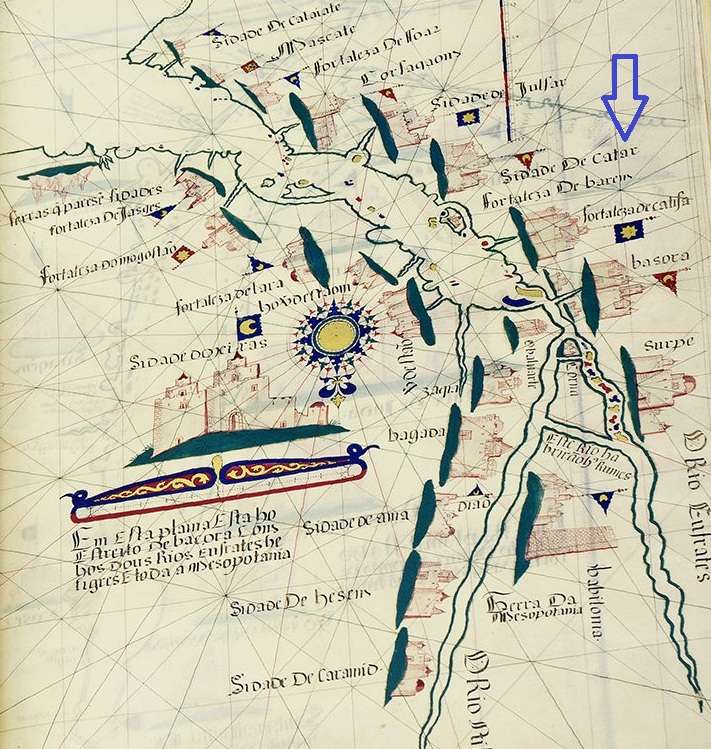
Qatar's coast entered the European record through Portuguese eyes. Portuguese navigators referenced the peninsula in the 1580s and 1590s, and it appears in the Atlas de Lázaro Luís of 1563 — one of the great Portuguese portolan atlases, now held by the Academy of Sciences in Lisbon. Through the sixteenth and seventeenth centuries Portuguese traders worked these waters, drawn by the pearl banks of Al Zubarah, where a Portuguese merchant recorded buying horses, dates, linens, and above all pearls.
The most tangible tie, though, is a recent one. At Katara Cultural Village on Doha's coast, the walkways are laid with calçada portuguesa — the handcrafted mosaic pavement of black and white stone, the same craft that lines the avenues of Lisbon. A piece of Portugal, set into the ground at the cultural heart of Qatar.
Qatar Today
Small nation, global reach.
Qatar is the world's leading exporter of liquefied natural gas, and it has turned that wealth outward — a diversified economy spanning finance, logistics, tourism, and culture, guided by Qatar National Vision 2030 and shown to the world at the 2022 FIFA World Cup. The Qatar Investment Authority is among the most significant sovereign investors on the planet, with landmark real estate holdings across Europe.
For Portugal, Qatar is a mature and growing partner — bilateral trade has been climbing, and Portugal's position on the Atlantic, inside the European Union, offers Qatari capital and families a stable gateway to Europe. What they value here is a counterpart on the ground who reads the relationship accurately.
Where This Meets Our Work
The Portuguese end of a Qatari mandate.
Qatari interest in Portugal tends to arrive in one of three forms, and each is handled differently. A family acquiring a second residence — on the Cascais coast, or a discreet estate in Comporta — where privacy and the right holding structure matter more than headline price. A family office, or institutional capital in the mould of the Qatar Investment Authority, taking an allocation to Portuguese real estate for risk-adjusted return and capital preservation. And development capital, underwritten on the numbers, where sourcing and local execution decide the outcome.
Qatari capital already shapes Europe’s great capitals — the towers and prime residential quarters of London, the classic Haussmannian addresses of Paris. Lisbon is the natural next entry on that map: not a cheaper alternative, but an earlier one — a European capital with genuine room to run, full EU access, and prime assets still priced well below those mature markets. Where London and Paris no longer offer meaningful upside, Portugal still does.
In each, we are the party on the ground here who sources it, structures it, and holds it — with legal, tax, and immigration coordinated through dedicated partners. The corridor between the Gulf and Portugal is the one Luznur Capital was built around, held to the discretion the relationship deserves.
Reference
Diplomatic relations established · 1982.
Official & further reading
Continue with Luznur Capital
Transparency · Confidentiality · Execution
Luznur Capital is the commercial name of Lusomena Investments, Unipessoal Lda., a licensed real estate brokerage holding AMI 22354. This page is offered for cultural and informational purposes and reflects the historic and diplomatic ties between Portugal and the State of Qatar; it does not constitute legal, tax, immigration, or investment advice.
Lusomena Investments, Unipessoal Lda. · AMI 22354 · info@luznurcapital.com · +351 932 224 792