 (+351) 932 224 792
  info@luznurcapital.com
Real estate for wealth preservation in Portugal
Why family offices and international investors are buying Portuguese property to protect capital, not chase returns
Portugal has become one of the few markets in Europe where serious capital can be placed and reasonably expected to be there, intact and productive, in twenty years. That is the question wealth preservation actually asks. It is not the same question as “where is the highest yield” or “where will prices grow fastest.” It is the harder question. And right now, Portugal answers it better than most.
Key takeaways:
- Portugal offers euro-denominated assets in a politically stable EU and NATO jurisdiction
- Prime markets are structurally supply-constrained, which protects long-term value
- Lisbon gross rental yields currently range from around 4% to 6.4% depending on segment
- Property values rose 17.7% year on year in Q3 2025, the second-fastest in Europe
- The property route under the Golden Visa closed in October 2023, but the case for Portuguese real estate is independent of any residency program
- Off-market acquisitions remain the dominant route for serious preservation mandates
What does wealth preservation actually mean in real estate?
Wealth preservation is not wealth growth. The job is to protect existing capital from being eroded by inflation, currency debasement, political risk, or asset-class volatility. The aim is not to win. It is to not lose.
Real estate has carried this role for a long time because it does several things at once that few other assets manage. It is a physical, useful, tangible asset. It generates income. It tracks inflation reasonably well. And it does not move in lockstep with public markets.
For an investor sitting in a country with currency volatility, political turbulence, or weak property rights, buying real estate in a stable jurisdiction is often the first step in any serious capital protection plan. The honest question is not whether to allocate to real estate. It is where.
Why does Portugal stand out right now?
A few reasons, and they reinforce each other.
Institutional stability. Portugal has been an EU member since 1986, is a founding NATO member, and is a Eurozone economy with an independent judiciary built on Roman law. Foreign buyers face no ownership restrictions. Title is constitutionally protected. The country has held continuous democratic governance since 1974 and consistently scores in the top tier of global rule-of-law indices. For preservation mandates, that institutional backdrop is the non-negotiable starting point. As of 2026, Portugal is also the 7th safest nation in the world by the Global Peace Index.
Euro-denominated assets. For investors based in regions with weak or volatile currencies, the simple act of holding an asset priced in euros is, by itself, a portfolio decision. The euro is one of the world’s principal reserve currencies. Buying a Portuguese asset is not a bet on Portugal alone. It is a structural hedge against domestic currency exposure.
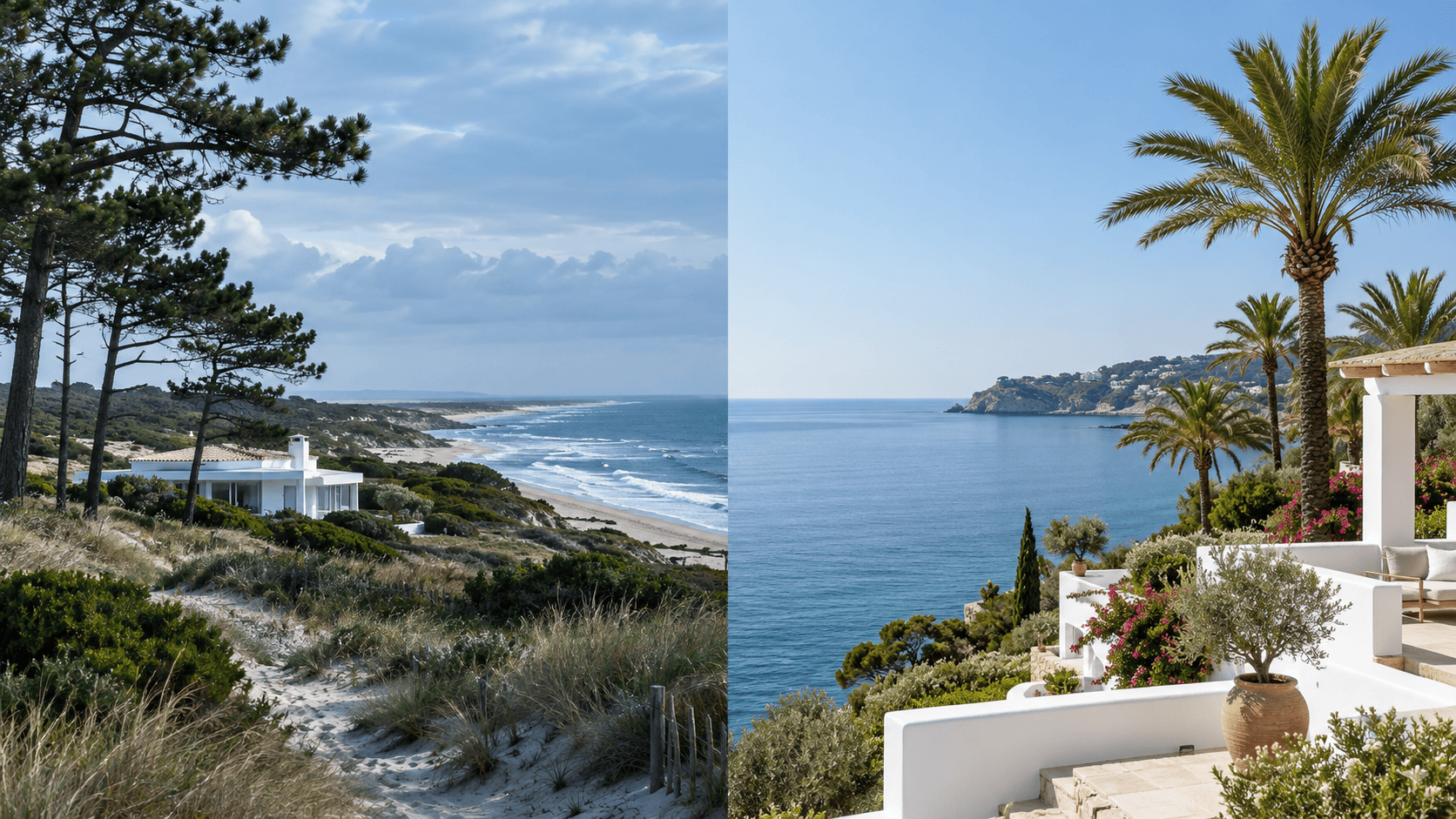
Supply that cannot be replicated. The most durable preservation assets share one trait: scarcity that does not go away. In Portugal, that scarcity is geographic and regulatory. You cannot build another Lapa. You cannot extend the buildable coastline of Cascais. Comporta sits inside a protected natural reserve. Quinta do Lago is essentially finished as a development plot. These constraints are why prime values in Portugal hold through downturns and grow when capital looks for somewhere safe to land.
What do the 2026 numbers actually show?
Portugal was the second-fastest-growing housing market in Europe in Q3 2025, with values up 17.7% year on year against a Eurozone average of 5.1%, according to Eurostat. By May 2026, the average price per square meter in Lisbon reached €6,315, up 8.6% year on year. Prime neighborhoods like Chiado, Lapa, and Príncipe Real sit well above that.
The Savills 2026 World Cities Prime Residential Index placed Lisbon in the top five globally for forecast capital growth, projecting 4% to 5.9% appreciation this year. The global average across the index is 1.3%. Portugal Pathways’ Property Market-Index puts top Lisbon neighborhoods at a score of 180 against a benchmark of 100, with forecast growth of an additional 5.8% through year-end.
Gross rental yields on Lisbon apartments sit between roughly 4% and 6.4%, depending on segment and district. Smaller units in the 40 to 50 square meter range deliver the higher end of that range. The Algarve runs broadly similar, with prime resort assets in Quinta do Lago and the Golden Triangle holding ground at the top end despite higher entry costs. ECB rate cuts in 2025 brought average bank lending rates down to 3.78% by early 2026, which expanded the buyer pool without softening prices.
A note on the Golden Visa. The property investment route closed in October 2023 under Law 56/2023. Foreign capital into Portuguese real estate has not declined since. The market does not need a visa attached to a property purchase to remain attractive, and the buyers it now attracts tend to be less transactional and more aligned with the kind of long-term holding that preservation strategies require.
The four reasons real estate works as preservation in Portugal
Capital protection in a tangible asset. Real estate cannot be created by central bank policy and cannot go to zero. Through the Portuguese financial crisis of 2010 to 2014, one of the worst contractions in the country’s modern history, prime real estate in Lisbon and the Algarve held value far better than equities. The recovery that followed was fast and durable.
Inflation linkage. As construction costs, labor, and land prices rise, so does the replacement value of existing assets. That puts a structural floor under valuations. Portuguese leases are typically indexed to the national consumer price index, so rental income retains its real purchasing power over time.
Low correlation with public markets. During the 2020 equity selloff and the 2022 bond dislocation, prime Portuguese property kept appreciating in nominal terms. That decorrelation is what makes it genuinely additive to a multi-asset portfolio rather than another beta exposure dressed up as diversification.
Tax-efficient structuring. Portugal allows for ownership structures that materially improve net preservation outcomes. Domestic holding companies, international holding vehicles, and the IFICI regime for qualifying foreign tax residents all offer optionality. The right structure depends on the investor’s home jurisdiction, family situation, and succession plan, and it has to be built with proper legal and tax counsel. We work alongside that counsel, not around it.
Which Portuguese markets actually preserve capital?
Lisbon prime. Lapa, Príncipe Real, Avenida da Liberdade, Chiado, Estrela. Historic scarcity, sustained capital inflows, and the deepest liquidity of any Portuguese market. The market-index scores of 180 versus a benchmark of 100 speak for themselves.
Cascais and Estoril. Coastal premium, limited buildable supply, established expatriate and international family demand. Family-mandate territory. Strong resale market. Liquidity is high.
Comporta. Ultra-low density. Protected reserve. A brand at the European level. Land and villa acquisitions here transact more slowly but hold value disproportionately well. This is one of the markets where off-market dominates and where the wrong intermediary costs you the asset.
Quinta do Lago and the Golden Triangle. International resort demand, established golf and lifestyle infrastructure, UHNW residential. Medium-to-high liquidity at the top of the market.
Madeira. Island geography, the International Business Center regime, and a growing profile among investors looking at structuring and lifestyle in combination. The market is still developing in depth, which means selectivity matters more than in mainland prime.
Why off-market matters for preservation
A large share of the mandates we run at Luznur Capital involve off-market assets. The reason is worth saying plainly.
Properties transacted outside the public market are usually priced without the speculative premium that builds up in listed inventory. They are often unique, the kind of asset that cannot be replicated, which is where the most durable value sits. And the process around them allows for proper due diligence, structured negotiation, and confidentiality, which matters when the buyer is a public figure, a family office, or an institution that does not want its position visible.
Off-market is not cheaper. It is a different quality of asset. That is the distinction.
Common questions from preservation-focused investors
Is Portuguese real estate exposed to political risk?
Portugal is among the most politically stable countries in Southern Europe. Continuous democratic governance since 1974, full EU and NATO membership, an independent judiciary, and constitutional protection of property rights. No history of arbitrary expropriation or capital controls aimed at foreign investors. 7th safest nation in the world by the GPI 2026.
What is the minimum sensible investment size?
Prime residential preservation mandates in Lisbon or the Algarve typically start at €750,000 to €1 million for a meaningful asset. Comporta and off-market opportunities usually start higher. For investment-grade commercial or development assets with preservation characteristics, the entry point is closer to €2 million to €5 million. The number matters less than the quality, scarcity, and liquidity of the specific asset.
How should the asset be held?
That depends on the investor’s jurisdiction, tax residency, family structure, and succession plan. Options range from direct personal ownership to Portuguese domestic holding companies (Lda or SA) to international vehicles. Each carries different implications for IMT (the property transfer tax), stamp duty, annual IMI, inheritance, and income distribution. We coordinate with our network of legal and tax partners on structuring before any acquisition.
Does Portuguese real estate hedge inflation?
Yes, through two mechanisms. The asset itself appreciates in supply-constrained markets at or above inflation. And rental income is indexed to CPI through standard lease clauses. Over rolling ten-year holding periods in prime Portuguese markets, real returns have been positive in every decade since 1990, including across the 2010 to 2014 crisis period.
Did the end of the property-based Golden Visa change the case for buying in Portugal?
No. The closure of the property route in 2023 changed the buyer mix, not the fundamentals. If anything, it removed a layer of transactional buyers and left a more aligned base of long-term capital. Preservation buyers were never primarily attracted by the visa, usually today those buyers are non-resident in Portugal.
Why family offices are increasing their Portuguese allocations
Over the past five years we have seen a steady increase in family office capital coming into Portuguese real estate, particularly from the Gulf, Northern Europe, Brazil, and South Africa. The drivers are consistent: political stability, euro denomination, a functioning legal system, optional residency pathways, and a European footprint with Atlantic-facing geography.
Portugal is not a high-beta growth story. It does not pretend to be. The proposition is European, sophisticated, and built for capital that wants to be preserved, grown moderately, and passed across generations. That is a different proposition from speculative emerging-market property, and it is the right one for serious preservation mandates.
The bottom line
Wealth preservation comes down to confidence. Confidence that your title will be protected. Confidence that the currency will hold its value. Confidence that the political environment will stay stable. Confidence that there will be a buyer when you eventually need liquidity. Portugal, in the current environment, gives you all four.
This is not a market for short-term speculation. It is a market for investors who think in decades, who prefer assets they can stand on, and who recognize that in a world where capital protection is harder than it used to be, owning a well-located piece of Europe is itself a strategy.
For international investors and family offices building or rebalancing a real estate allocation, Portugal is not exotic diversification. It is a core holding.
Speak with Luznur Capital.
We advise international investors and family offices on acquisition, structuring, and preservation mandates across Portugal’s premium markets, including off-market opportunities. To discuss a specific mandate, write to info@luznurcapital.com or visit www.luznurcapital.com.
Disclaimer: This article is for informational and educational purposes only. It does not constitute financial, legal, or tax advice. All investment decisions should be made in consultation with qualified legal, tax, and financial advisors. Past market performance does not guarantee future results.
Tag:
Category:
- Alentejo (1)
- Algarve (15)
- Almancil (5)
- Buyer Guides by Nationality (6)
- Buying in Portugal (21)
- Cascais (6)
- Comporta (6)
- Costs & Fees (2)
- Country Comparisons (3)
- D7 Visa (5)
- D8 Visa (4)
- Diplomacy (1)
- Eastern Algarve (3)
- Economy (9)
- Estoril (5)
- Foreign Bilateral Relations (3)
- GCC (2)
- GCC Investors Portugal (2)
- Golden Triangle Algarve (5)
- Golden Visa (1)
- Golden Visa Portugal (2)
- HNWIs (16)
- International Buyers (24)
- Investing in Portugal (29)
- Investment (6)
- Investment & Advisory (15)
- Investment & Structuring (1)
- Lisbon (11)
- Lisbon (5)
- Market Data (6)
- Market Guides (8)
- Porto (6)
- Portugal (16)
- Quinta da Marinha (6)
- Quinta do Lago (11)
- Real Estate Portugal (32)
- Relocating to Portugal (14)
- Relocation (1)
- Residency & Investment (2)
- Sotavento Algarve (3)
- Tavira (7)
- Tourism (4)
- Vale do Lobo (5)
- Vila Real de Santo António (1)
- Vilamoura (5)
- Wealth Management (1)
- Wealth Management Portugal (4)