 (+351) 932 224 792
  info@luznurcapital.com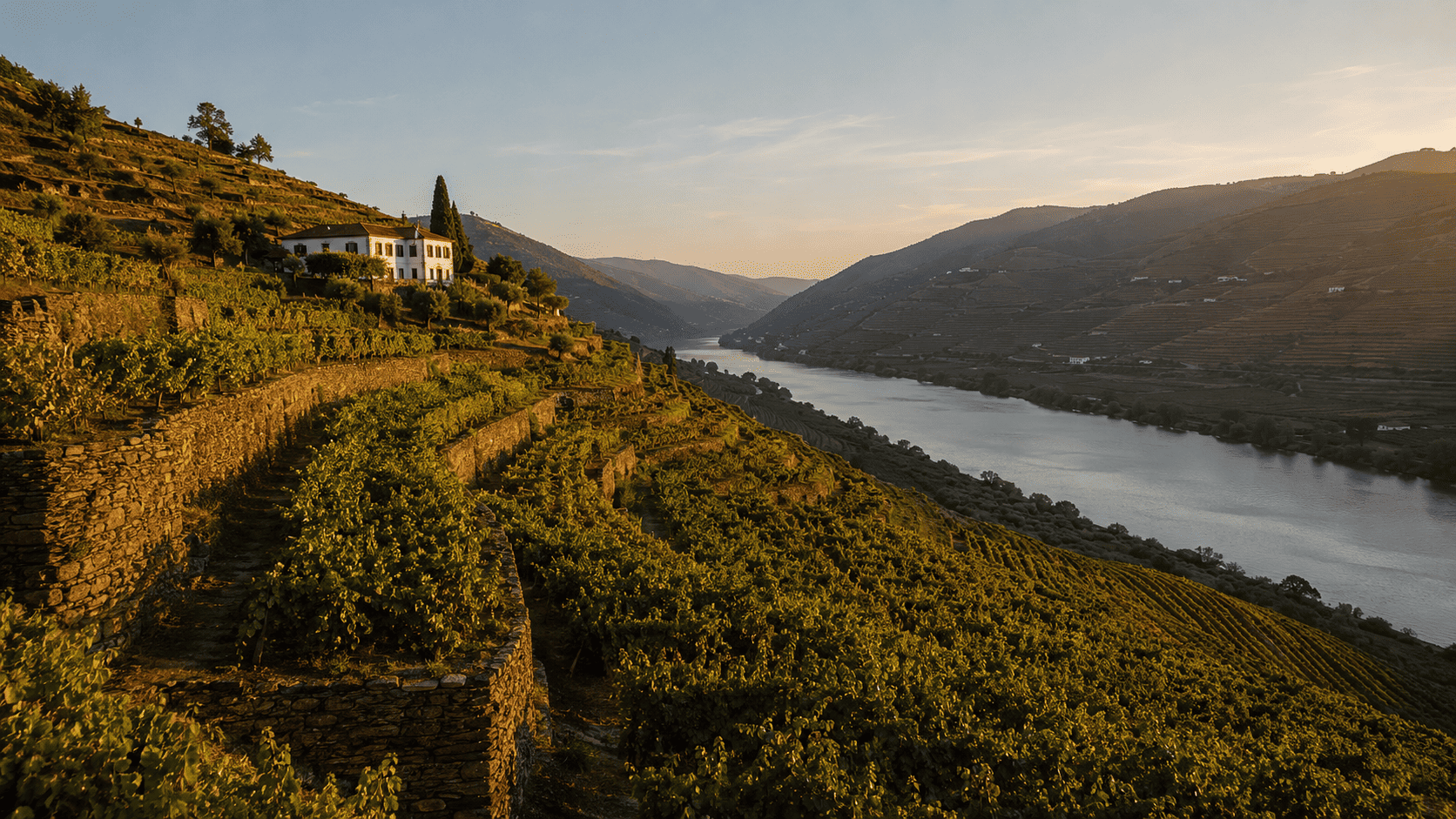
Douro Valley property and vineyard investment
Buying a quinta in the Douro: the business you are actually acquiring
Most people who buy a quinta in the Douro want the view, the house, and a few weeks of harvest romance. Very few want to become farmers.
That is a reasonable position, and it is achievable. What is not achievable is buying a Douro property with vines on it and treating the vines as landscaping. Registered vineyard in the Alto Douro carries obligations, an annual production allocation, a classification that determines its value, and neighbours with a direct interest in whether it is maintained. You inherit all of it on the day of the deed.
The workable model for a lifestyle buyer is straightforward and widely used: own the land, live in the house, and let a professional producer farm the vines under a proper arrangement. That produces income, keeps the terraces alive, and removes the labour. It also requires getting the legal structure right, which is where these purchases most often go wrong.
What the Douro is
The world’s oldest officially demarcated wine region, established in 1756, and a UNESCO World Heritage cultural landscape. Terraced schist slopes falling to the river, walled by hand over centuries, in a valley sheltered from Atlantic weather by the Marão and Montemuro ranges. Hot dry summers, cold winters, and soil that is poor in nutrients but retains heat and forces vines deep for water.
Three sub-regions, running west to east:
Baixo Corgo, around Peso da Régua and Mesão Frio, is the wettest and most densely planted, closest to Porto, and generally the least expensive.
Cima Corgo, centred on Pinhão, Alijó, Sabrosa, and Tabuaço, holds most of the historic Port quintas and the highest-classified vineyard. This is the postcard Douro and it prices accordingly.
Douro Superior, east toward Torre de Moncorvo and the Spanish border, is hotter, drier, more remote, and considerably cheaper, with a growing reputation for table wine.
Adjacent but distinct is Távora-Varosa around Tarouca and Lamego, a separate demarcated region known for sparkling wine, where property is cheaper and the rules differ.
Porto is roughly ninety minutes to two hours from Régua and Pinhão by road, with a rail line following the river and international connections through Francisco Sá Carneiro.
What is on the market
The listings range from ruins to producing estates, and the headline figures mislead badly.
Portuguese portals currently carry close to two hundred quintas in the Douro starting from around €33,000. Those bottom-end properties are typically stone houses in ruins on small plots, or remote parcels with no services and no meaningful vineyard — restoration projects requiring a budget several times the purchase price.
The realistic bands for a lifestyle buyer:
€150,000 to €400,000 buys a small farm needing work: an unrestored or partly restored stone house, a few hectares, often with old vines, olive trees, and fruit, generally away from the river or in the Douro Superior.
€400,000 to €900,000 buys a habitable quinta with several hectares, frequently with some registered vineyard and outbuildings — a wine press, storage, a water tank — and often a partial view.
€900,000 to €2.5 million buys a restored or well-maintained quinta with a genuine river or valley view, meaningful vineyard, and usable outbuildings. This is where most international lifestyle buyers land.
Above €2.5 million moves toward estates with substantial registered vineyard, brand history, or established tourism operations — which is a different purchase with different diligence.
Larger properties exist at all levels: riverfront farms of sixty-plus hectares, nine-hectare estates carrying tens of thousands of vines. Hectarage tells you very little on its own, because a hectare of highly classified riverside terrace and a hectare of scrub on a north-facing slope are not comparable assets.
The vines: what you are actually acquiring
This is the part no general property guide explains, and it determines both value and obligation.
Vineyard is registered. Plots that may produce for the Douro DOC are entered in a cadastre maintained by the Instituto dos Vinhos do Douro e do Porto. Vines outside that register are not eligible, whatever they are growing.
Registered vineyard is classified. The region operates a long-standing scoring system that grades each plot on factors including altitude, gradient, aspect, soil, vine age, density, and grape variety. The resulting grade is the single largest determinant of what the plot is worth and what it may produce.
The benefício is an annual quota. Each year the IVDP sets how much wine may be fortified into Port, and allocates that entitlement across registered plots according to classification. This matters enormously, because fortifying into Port is generally the highest-value outlet for the fruit. Two neighbouring plots with identical vines can have materially different economics depending on their grade and allocation.
Property listings in the region reflect this. Advertisements routinely specify that a vineyard has “production for Port wine with benefit,” because it is a value attribute rather than a technicality.
What to establish before buying: the registered area, its classification, the benefício allocation history over recent years, the age and condition of the vines, the grape varieties planted, and whether any existing supply arrangement or lease is in place. None of this is visible from the landscape, and a seller’s description is not evidence.
Leasing the vines to a producer
The model most lifestyle buyers want — keep and eat some grapes, let a professional make money from the rest — is common in the Douro and works well when structured properly. It is also more legally involved than buyers expect.
The commercial logic is sound. A neighbouring producer wants your fruit precisely because your plot carries a registered classification and an allocation. Established quintas routinely buy grapes from smaller neighbours, and for a producer, secure access to well-sited registered vineyard is genuinely valuable. That gives you a real negotiating position rather than a favour to ask.
Several structures exist, and they are not equivalent. The land may be leased to the producer. The producer may be engaged to farm it under a services arrangement while you retain the crop and sell it. You may simply contract to sell fruit each year while remaining responsible for cultivation. Each allocates cost, risk, and control differently, and each has different consequences for who holds the registration and the allocation.
The point requiring real care is Portuguese agricultural tenancy law. Rural leases in Portugal are a regulated form of contract with statutory requirements and protections for the tenant, and they are not the informal handshake a foreign buyer typically imagines. A poorly documented or wrongly categorised arrangement can be considerably harder to end than to begin, and that can affect both your use of the land and your ability to sell it. Any arrangement should be drafted by a Portuguese lawyer with agricultural experience before completion, and the position on any existing arrangement should be established during diligence — not after.
Yield expectations should be modest. For a small lifestyle holding of a few hectares, income from leasing or grape sales typically covers maintenance, some of the property taxes, and little more. It is a mechanism for keeping the land productive and the terraces standing rather than a return on the purchase.
Letting the vines go is not an option
Worth stating plainly, because buyers occasionally assume it is.
Unmaintained vineyard becomes a problem for everyone around it. Disease and pest pressure spreads to neighbouring plots, dry abandoned vines raise fire risk in a hot dry valley, and terraces deteriorate without upkeep. Registration and classification depend on the plot being genuinely cultivated, so abandonment can erode the very attribute that gives the land its value.
In a UNESCO cultural landscape where the terracing is the heritage, neglect is also a planning and reputational issue rather than a private matter. The lease-to-a-producer model exists partly because the alternative is not doing nothing — it is watching an asset degrade.
UNESCO, and what you can build
The Alto Douro Vinhateiro’s World Heritage status protects the landscape, which means the terraces, the walls, the vineyard pattern, and the built vernacular.
Practical consequences: alterations to existing buildings are constrained, new construction is heavily restricted, terrace modification is controlled, and works may require heritage as well as municipal approval. Timelines are longer than elsewhere in Portugal, and renovation budgets built on Lisbon or northern European assumptions will be wrong.
Portuguese land classification applies on top. Land is urbano or rústico, and rustic land does not carry residential development rights as a matter of course. The pre-existing registered ruin route has narrowed considerably, and municipalities have become less willing to treat a collapsed wall as a dwelling. REN and RAN overlays apply independently of the municipal plan.
The only reliable answer on what may be built or altered is a written viability opinion from the relevant câmara municipal, obtained before any deposit is committed.
The physical realities
Gradient. Douro terraces are steep enough to limit mechanisation, which is why labour costs here exceed those of flat vineyard regions and why comparisons imported from other countries mislead. It also means access to parts of your own land may be difficult.
Terrace walls. Dry stone retaining walls are the structural system holding the hillside. Their condition is a material diligence item and repair is skilled, slow, and expensive.
Water. The valley is hot and dry in summer. Springs, boreholes, tanks, and abstraction rights should be identified and their licensing verified.
Access. Legal rights of way over intervening land, and the physical condition and ownership of the track. Many quintas are reached by roads that are not municipal.
The house. Schist and granite construction, generally uninsulated, frequently closed for years. Timber floor and roof structures decay where they bear into masonry, and the damage is invisible until floors are opened. A survey without opening up is not a survey.
Registry against reality. Rural Douro property routinely carries discrepancies between the land registry, the tax record, and what physically stands. Outbuildings, boundaries, and historic extensions all need reconciling, and any discrepancy becomes yours at completion.
Hospitality, realistically
Wine tourism in the Douro is genuine and growing. The valley supports several hundred accommodation properties, from converted quintas to established hotels, and the model of restoring a quinta into small-scale guest accommodation is well proven.
For a lifestyle buyer the realistic version is more modest: letting the property, or a guest wing, when you are not using it.
Two points matter. Licensing routes differ — turismo rural and turismo no espaço rural are distinct regimes from residential Alojamento Local registration, with different requirements, different treatment, and different implications for what you can build and how you are taxed. The route should be chosen before purchase, because it affects the renovation.
And EU Regulation 2024/1028 came fully into force in May 2026, requiring booking platforms to verify national registration numbers before publishing a listing. Informal operation is no longer viable.
Seasonality is pronounced. Demand concentrates around harvest in September, spring, and summer, and the valley is quiet in deep winter. Model actual lettable weeks rather than annualising peak rates.
Who buys here
The Douro is a majority-domestic market, which distinguishes it sharply from the Algarve or the Minho.
In the nearest comparable market, across the river from Porto — at 33% international buyers against 67% domestic, with Americans, British, and French the leading overseas nationalities in the north. There are also many Brazilian private buyers and investors who are discovering the region. The valley itself is more domestic still: Portuguese families, Porto buyers acquiring weekend property, and agricultural purchasers.
International interest concentrates around Régua, Pinhão, and the higher-profile riverside stretches, and skews toward buyers with a genuine wine interest rather than pure lifestyle relocators.
That domestic base is a stability feature. A market that does not depend on any single foreign economy behaves differently when that economy weakens.
Liquidity and living
Resale is slow. Rural property is the least liquid segment of the Portuguese market. Ordinary resale nationally runs 90 to 120 days; rural houses and renovation projects can sit past 150 and frequently far longer. Buy for use over a long horizon, not for a five-year exit.
Services are thin. Régua, Lamego, and Vila Real have hospitals and supermarkets; much of the valley does not. Winters are cold and the population is ageing and declining in many parishes.
Language matters. English is not widely spoken outside the wine trade and the tourism operations. Functional Portuguese is closer to a requirement than an advantage for dealing with neighbours, contractors, and the municipality.
The compensation is real. The Douro at first light in October, from a terrace above the river, is among the more remarkable places to own a house in Europe. Buyers who understand what they are taking on tend to stay.
Diligence specific to the Douro
Confirm the vineyard registration, classification, and benefício allocation history with documentation rather than description.
Establish whether any lease, tenancy, or supply arrangement exists over the land, and what it would take to end or vary it.
Obtain written viability confirmation from the municipality for any construction or alteration contemplated, and check REN, RAN, and heritage designations against the specific parcel.
Assess terrace wall condition, water rights, and legal and physical access.
Survey the building structurally, including opening up floors on any older stone house.
Reconcile the land registry, the tax record, and the physical property.
Decide the letting route — tourism licensing or residential AL — before the renovation, not after.
How Luznur Capital works in the Douro
Off-market access. A substantial share of the better Douro quintas never reaches a portal. Estates change hands privately between families, producers, and their advisers, and public listings are frequently what those channels have already passed over. Luznur Capital operates within the off-market agent networks through which that inventory moves, and sources against a defined brief rather than presenting what is publicly available.
Assembling the right specialists for the transaction. A Douro purchase requires expertise that no brokerage holds in-house: agricultural and viticultural assessment of the vines and terraces, legal review of registration, classification, and any tenancy, planning confirmation from the municipality, and structural survey of older stone buildings. These are engaged for the specific property, through Portuguese professionals appropriate to the asset, and coordinated so the findings arrive before a promissory contract puts a deposit at risk rather than after.
Structuring the vineyard question. Establishing what arrangement suits the buyer’s actual intention — leasing, a services arrangement, or fruit sales — and having it drafted properly by a lawyer with agricultural experience, so the terraces stay productive without the owner becoming a farmer.
Honest counsel on fit. The Douro suits a specific buyer and disappoints others. Where the requirement points toward the Minho, the coast, or somewhere with services and liquidity, saying so is the service.
FAQ
How much does a quinta in the Douro cost?
Listings range from around €33,000 for ruins and remote parcels to several million for producing estates. For a lifestyle buyer, €150,000 to €400,000 buys a small farm needing substantial work, €400,000 to €900,000 a habitable quinta with some vineyard, and €900,000 to €2.5 million a restored property with a genuine river or valley view. Hectarage alone tells you little, since plot classification varies enormously.
Do I have to farm the vines myself?
No, but you cannot ignore them. The common model is to lease the vineyard to a neighbouring producer or engage one to farm it, which produces modest income and keeps the terraces maintained. Abandonment is not a viable alternative, since unmaintained vines create disease and fire risk and can erode the registration and classification that give the land value.
What is the benefício?
The annual quota set by the Instituto dos Vinhos do Douro e do Porto determining how much wine may be fortified into Port, allocated across registered plots according to their classification. Because fortification is generally the highest-value outlet for the fruit, a plot’s classification and allocation history are central to what it earns — and neither is visible from the landscape.
Can I sell my grapes to a Port producer?
Commonly, yes. Established quintas routinely buy fruit from smaller neighbours, and secure access to well-sited registered vineyard has real value to a producer. That gives an owner a genuine negotiating position. The structure of the arrangement — lease, services contract, or fruit sale — should be drafted by a Portuguese lawyer with agricultural experience.
Is leasing agricultural land in Portugal straightforward?
It requires care. Rural leases in Portugal are a regulated form of contract with statutory requirements and protections for the tenant, rather than an informal arrangement. A wrongly structured agreement can be harder to end than to begin, and may affect both your use of the land and a future sale. Establish the position on any existing arrangement during diligence.
What does UNESCO status mean for building?
The Alto Douro Vinhateiro is a World Heritage cultural landscape, so alterations to buildings, new construction, and terrace modification are all constrained, and approvals may involve heritage as well as municipal authorities. Portuguese land classification applies on top, with rustic land carrying no automatic residential development rights. Obtain written viability confirmation from the municipality before committing funds.
Which part of the Douro should I buy in?
Baixo Corgo around Régua and Mesão Frio is closest to Porto and generally least expensive. Cima Corgo around Pinhão, Alijó, and Sabrosa holds the historic quintas and the highest-classified vineyard, priced accordingly. Douro Superior toward Torre de Moncorvo is hotter, more remote, and considerably cheaper.
Who buys property in the Douro?
Predominantly Portuguese buyers, including Porto families acquiring weekend property and agricultural purchasers. Engel & Völkers records Vila Nova de Gaia, the nearest comparable market, at 33% international against 67% domestic, with Americans, Britons, and French the leading overseas nationalities in the north. International interest in the valley concentrates around Régua and Pinhão.
Can I run the quinta as guest accommodation?
Yes, and wine tourism in the valley is well established. Turismo rural and turismo no espaço rural are distinct licensing regimes from residential Alojamento Local, with different requirements and tax treatment, and the route should be chosen before renovation because it affects what you build. EU Regulation 2024/1028 now requires platforms to verify registration numbers, so informal operation is no longer viable.
How long does it take to sell a Douro property?
Longer than urban property. Ordinary resale nationally runs 90 to 120 days, but rural houses and renovation projects can sit past 150 days and frequently much longer in thin markets. A Douro quinta should be bought for long-horizon use rather than for a defined-term exit.
Is this article investment advice?
No. It presents general market and regulatory information as of August 2026 and is not a recommendation regarding any property. Vineyard registration, classification, allocation, tenancy, planning, and licensing positions are property-specific and must be verified independently before any commitment.
DISCLAIMER
Important information
This article is provided for general information only and reflects publicly available market and regulatory information as of August 2026. It does not constitute investment, financial, tax, legal, or agricultural advice, and is not a recommendation regarding any property or transaction.
Price ranges cited derive from listing platforms and market observation rather than notarial transaction records. The Douro is a low-volume market with highly heterogeneous property, and published figures are indicative of general conditions rather than valuations. Two properties of similar size and price can differ entirely in vineyard classification, allocation, condition, and development potential. Past price movements are not a guide to future performance.
Vineyard registration, classification, and production allocations are administered by the Instituto dos Vinhos do Douro e do Porto under rules that are set annually and are subject to change. Nothing here should be relied upon as a statement of the position applying to any particular plot.
Portuguese rural tenancy and agricultural leasing are governed by specific legislation carrying statutory requirements and protections. The general descriptions here are not a summary of that law, and any arrangement concerning land must be structured and documented by a qualified Portuguese lawyer with relevant experience. Land classification, construction viability, heritage restrictions, water abstraction rights, access, and tourism or short-term rental licensing are specific to each property and municipality and must be verified independently.
Luznur Capital is a licensed real estate brokerage and advisory firm (AMI 22354). It is not a law firm, agricultural consultancy, or planning authority. Independent legal, agricultural, planning, and technical advice should be obtained before any acquisition.
General information as of August 2026. Price data is indicative, not valuation, in a low-volume market with highly variable property. Vineyard registration, classification, allocation, leasing, and building rights are property-specific and must be verified with the relevant authorities and a qualified Portuguese lawyer. Not investment, legal, or agricultural advice. Luznur Capital (AMI 22354).
Considering a quinta in the Douro
What the vines are registered as, what they are allowed to produce, and what arrangement keeps them farmed are the questions that decide whether a Douro purchase works — and none is answerable from a listing.
Luznur Capital advises international buyers on Douro acquisitions, including off-market inventory, coordinating the agricultural, legal, planning, and technical specialists a quinta purchase requires.
To discuss a specific requirement, contact info@luznurcapital.com.
Tag:
Category:
- Alentejo (1)
- Algarve (15)
- Almancil (5)
- Buyer Guides by Nationality (6)
- Buying in Portugal (22)
- Cascais (6)
- Comporta (6)
- Costs & Fees (2)
- Country Comparisons (3)
- D7 Visa (5)
- D8 Visa (4)
- Diplomacy (1)
- Eastern Algarve (3)
- Economy (9)
- Estoril (5)
- Foreign Bilateral Relations (3)
- GCC (2)
- GCC Investors Portugal (2)
- Golden Triangle Algarve (5)
- Golden Visa (1)
- Golden Visa Portugal (2)
- High-Profile Clients (1)
- HNWIs (16)
- International Buyers (24)
- Investing in Portugal (29)
- Investment (6)
- Investment & Advisory (17)
- Investment & Structuring (1)
- Lisbon (5)
- Lisbon (11)
- Market Data (8)
- Market Guides (8)
- Porto (6)
- Portugal (16)
- Quinta da Marinha (6)
- Quinta do Lago (11)
- Real Estate Portugal (32)
- Relocating to Portugal (14)
- Relocation (1)
- Residency & Investment (2)
- Sotavento Algarve (3)
- Tavira (7)
- Tourism (4)
- Vale do Lobo (5)
- Vila Real de Santo António (1)
- Vilamoura (5)
- Wealth Management (1)
- Wealth Management Portugal (4)