 (+351) 932 224 792
  info@luznurcapital.com
Can You Live on $5,000 a Month in Portugal?
Short answer: yes — comfortably. But the real question is what kind of life $5,000 actually buys you here, and for whom it makes sense?
For most Americans, GCC nationals, and Latin American families exploring Portugal as a base, $5,000 a month is the threshold where things get genuinely interesting. Below it, you’re making compromises. At it, you’re living well. Above it — which is where many of our clients land — Portugal starts looking like an exceptional value proposition for a lifestyle that would cost two to four times more in comparable Western cities.
Let’s be specific about what that money actually gets you:
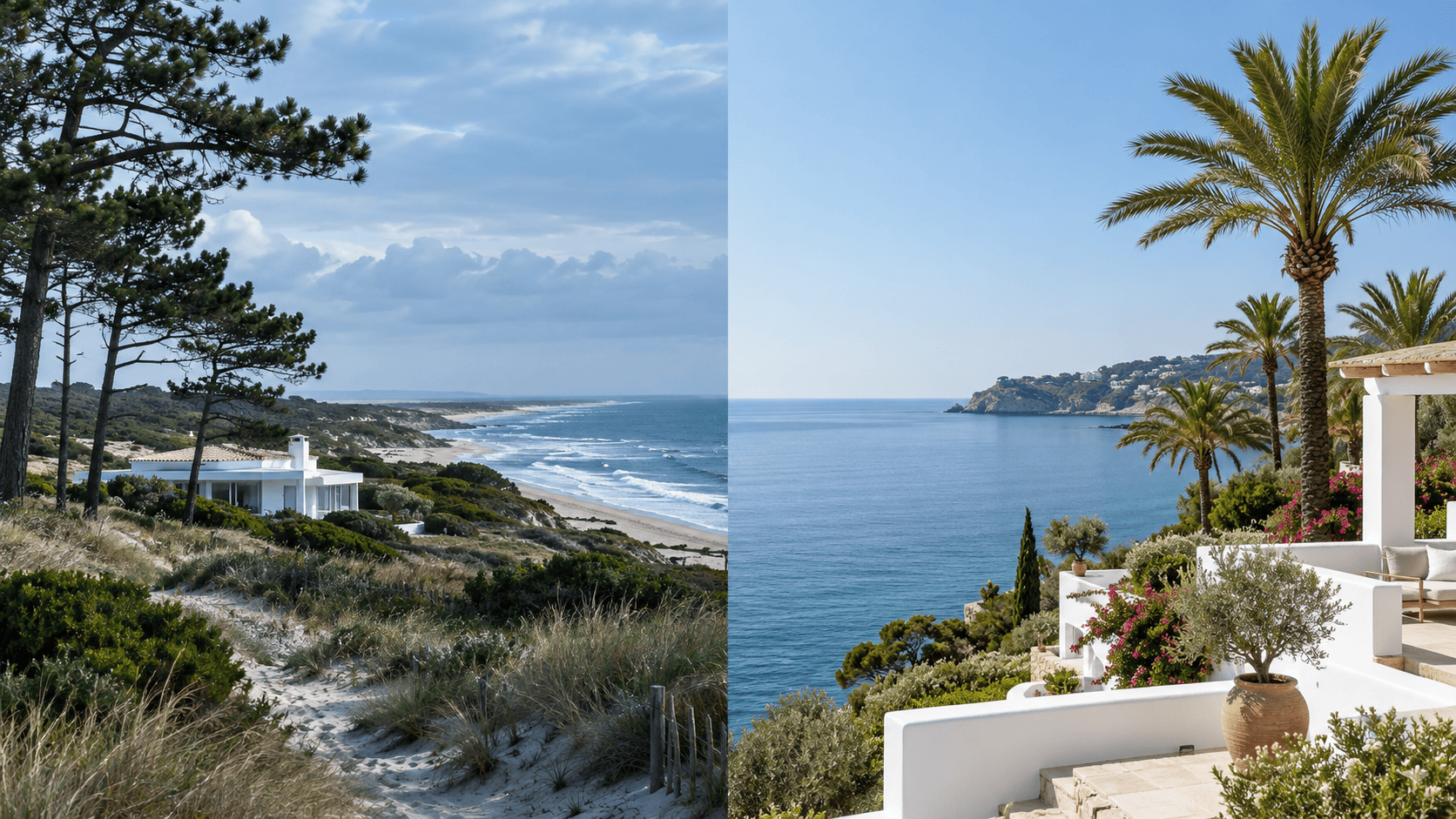
A scenario Breakdown: Lisbon/Cascais VS Algarve
Portugal’s average cost of living is the lowest in Western Europe. A single person spends around €650–750 per month on day-to-day expenses, excluding rent (Numbeo, 2026). A couple in Lisbon runs closer to €1,450–1,770 per month, again before housing.
Housing is where budgets diverge — and where location choices matter most.
At $5,000 a month (roughly €4,600 at current rates), here’s what a realistic breakdown looks like for a couple in two different regions:
1) Lisbon / Cascais
- Rent (2BR apartment): €1,800–2,500
- Groceries | €400–500
- Dining out | €400–600
- Transport | €150–250
- Healthcare (private) | €150–250 (look for family or corporate packages)
- Leisure | €400–700
2) Algarve (Excluding Quinta do Lago, Vale do Lobo, and other premium locations)
- Rent (2BR apartment) | €950–1,400
- Groceries | €300–400
- Dining out | €250–400
- Transport | €150–300
- Healthcare (private) | €150–250 (look for family or corporate packages)
- Leisure €300-500
So yes: $5,000 a month works in Lisbon. It works very comfortably in the Algarve’s smaller towns. In Setúbal, Azeitão, Arrábida, Porto, Aveiro, you’d live well and still have money left over each month.
What it doesn’t do is buy you a premium villa in Quinta do Lago, a private school for two children, and weekend dinners at Michelin-starred restaurants. For that lifestyle — which many of our clients want — the real number is closer to $10,000–20,000 per month, depending on property choices.
Where You Live Changes Everything
Portugal is not one market. It’s several very different ones, and the lifestyle each offers is distinct enough that the question “can I live on $5,000?” has a different answer depending on which part of the country you’re asking about.
Lisbon is a European capital with urban energy, culture, and serious infrastructure. Cascais, 30 minutes west, is where many international families tend to settle — quieter, with a good marina, international schools, and proximity to Lisbon’s airport and business district. Rent for a well-appointed two-bedroom apartment in Cascais runs €1,800–2,800 per month. $5,000 works here, with little room for extravagance.
Comporta and Tróia are a different proposition entirely. If Cascais is the European-family suburb, Comporta is the design-conscious retreat — white-sand beaches, rice fields, zero high-rises, and strict planning rules that keep it that way. It attracts a different crowd: architects, founders, artists, people who have made their money and want to disappear somewhere beautiful. $5,000 a month covers a comfortable life there. Property, on the other hand, has been appreciating at over 10% annually and is where we’ve had some of the most interesting investment mandates.
The Algarve — and specifically the Golden Triangle of Quinta do Lago, Vale do Lobo, and Vilamoura — is where the golf, the marina lifestyle, and the international resort infrastructure concentrate. Monthly rents in Quinta do Lago for a proper villa start well above what a $5,000 budget allows. But inland Algarve towns like Tavira (very popular amongst Americans) offer a genuinely beautiful, slower life at a fraction of that cost.
Madeira Island deserves its own mention. It’s increasingly popular with remote workers and retirees (D7 Visa) has a mild climate year-round, and is significantly cheaper than the mainland for comparable quality of life. $5,000 a month on Madeira buys a lot.
The Tax Picture in 2026 (And Why It Matters More Than Rent)
For high-net-worth individuals, the tax environment is often more significant than the cost of living. This is where Portugal’s story has changed, and it’s worth being direct about it.
The original Non-Habitual Resident (NHR) regime — which offered a flat 20% tax rate on Portuguese income and exemptions on most foreign-sourced income — officially ended for new applicants in early 2025. It was genuinely one of the most attractive tax structures available to international residents in Europe, and its discontinuation has prompted a lot of questions from clients.
What replaced it is the IFICI regime (NHR 2.0), which continues to offer a 20% flat rate on qualifying Portuguese professional income and exemptions on most foreign-sourced income — but with tighter eligibility criteria. The new regime focuses on professionals in technology, scientific research, and innovation. It’s less broadly accessible than the old NHR, but for the right profile, it remains compelling.
For Golden Visa holders who are not becoming Portuguese tax residents — those spending fewer than 183 days per year in Portugal — the standard progressive tax rates apply to Portuguese income, but global income from outside Portugal isn’t taxed in Portugal at all. Many of our international clients structure their residency precisely this way: they hold a Portuguese Golden Visa, maintain residency elsewhere for tax purposes, and use Portugal as a home base without becoming full tax residents.
If you are American, there’s an additional layer of complexity. The US taxes its citizens on worldwide income regardless of where they live, which means any tax planning needs to account for the US-Portugal tax treaty and FBAR obligations. Americans holding Golden Visa investment accounts above $10,000 have reporting requirements that kick in immediately. This is not a reason to avoid Portugal — but it is a reason to work with advisors who understand both sides.
We work closely with tax and legal partners who specialize in exactly these cross-jurisdictional structures. The regulatory environment is navigable; it just requires proper guidance from the start.
What $5,000 Doesn’t Cover — and What That Tells You
The upper limits of this budget, because it matters for the right kind of reader.
$5,000 a month will not comfortably cover:
- – Private international school fees for children (€12,000–25,000 per year per child at schools like St. Julian’s or Carlucci American International School of Lisbon)
- – A luxury villa rental in Quinta do Lago or Comporta (annual rentals for premium properties run €3,000–10,000+ per month)
- – Golf club membership at Quinta do Lago (membership title alone has historically run above €25,000)
- – Frequent air travel, yacht berths, or heavy international entertainment
- – Private membership clubs in Portugal
For clients in that tier — and many of the mandates we handle are — $5,000 is the baseline for daily expenses, not the total budget. The real question isn’t whether you can survive on $5,000; it’s what you’re trying to build here, and whether Portugal’s structure works for your life and your capital.
For a family that wants a proper base in Europe, access to Schengen, a stable political and legal environment, excellent private healthcare, and a quality of life that genuinely outperforms what the same money buys in London, Paris, or Dubai, Portugal is hard to argue against. Even at the premium end of the market, properties and operating costs are lower than comparable European alternatives.
Who This Makes Most Sense For
Americans looking to diversify their base or establish EU residency are among the most active buyers we work with, particularly post-2024. The Golden Visa offers a route to an EU passport after five years of residency, which is increasingly valued by American families who want optionality. Cascais and Lisbon are the most natural fits culturally and logistically.
GCC nationals and Arab investors are drawn to Portugal’s political stability, the absence of any cultural friction, strong Islamic finance compatibility through structures like trust funds, Golden Visa Funds compliant with sharia law, and family offices, and the directness of the transaction environment.
Latin American families — particularly Brazilian and Venezuelan — have long had strong ties to Portugal through language and culture (Venezuela has a big Portuguese community) The process of establishing residency tends to feel more familiar here than in other European countries, and Lisbon has a substantial, well-established LATAM expat community.
All of these groups share one thing: they’re not asking whether they can afford Portugal. They’re asking whether Portugal is the right structure for their life, their capital, and their family’s future. That’s the right question.
The Practical Bottom Line
$5,000 a month is genuinely enough to live a full, comfortable life in Portugal — in most regions, without compromising significantly on quality. It’s not enough to live the lifestyle that Portugal’s premium market can offer.
If you’re reading this and your budget is $5,000, Portugal is worth serious consideration. If you’re reading this and $5,000 is what you spend before your housing costs, the conversation is different — and far more interesting.
Portugal rewards people who take the time to understand it properly. The legal structure, the tax environment, the regional differences, and the off-market opportunities that never appear on listing portals — these are the things that separate a good move from a great one.
Luznur Capital advises foreign buyers and investors across Portugal’s premium property market — from Lisbon and Cascais to Comporta, the Algarve, Porto, Madeira. We handle acquisitions, capital placements, project exits, and residency structuring for private clients, family offices, and institutional mandates. If you’re considering Portugal seriously, we’d welcome a conversation.
Get in touch info@luznurcapital.com
Tag:
Category:
- Alentejo (1)
- Algarve (15)
- Almancil (5)
- Buyer Guides by Nationality (6)
- Buying in Portugal (21)
- Cascais (6)
- Comporta (6)
- Costs & Fees (2)
- Country Comparisons (3)
- D7 Visa (5)
- D8 Visa (4)
- Diplomacy (1)
- Eastern Algarve (3)
- Economy (9)
- Estoril (5)
- Foreign Bilateral Relations (3)
- GCC (2)
- GCC Investors Portugal (2)
- Golden Triangle Algarve (5)
- Golden Visa (1)
- Golden Visa Portugal (2)
- HNWIs (16)
- International Buyers (24)
- Investing in Portugal (29)
- Investment (6)
- Investment & Advisory (15)
- Investment & Structuring (1)
- Lisbon (11)
- Lisbon (5)
- Market Data (6)
- Market Guides (8)
- Porto (6)
- Portugal (16)
- Quinta da Marinha (6)
- Quinta do Lago (11)
- Real Estate Portugal (32)
- Relocating to Portugal (14)
- Relocation (1)
- Residency & Investment (2)
- Sotavento Algarve (3)
- Tavira (7)
- Tourism (4)
- Vale do Lobo (5)
- Vila Real de Santo António (1)
- Vilamoura (5)
- Wealth Management (1)
- Wealth Management Portugal (4)